Blog

What is net zero certification for businesses? The 3Rs Certification Standard explained

Climate Leadership

Reduce and Report

Restore through Carbon

Restore through Nature

Blog

What is net zero certification for businesses? The 3Rs Certification Standard explained

Climate Leadership

Reduce and Report

Restore through Carbon

Restore through Nature

Wind turbine landscape
Adam Boita

Chief Marketing Officer

5 min read

Wind turbine landscape

Corporate climate ambition has never been higher. But for most organisations, the gap between commitment and credible, structured action remains stubbornly wide. A landscape cluttered with overlapping standards, reporting frameworks, and methodologies makes it hard to know where to start, what counts as meaningful progress, or how to communicate it without greenwashing risk. Net zero certification in the UK changes that. Here's what it involves, why it matters commercially, and how Ecologi's 3Rs Certification Standard provides a practical pathway to credible climate leadership.

What does net zero actually mean for a business?

Net zero for business means reaching a state where the greenhouse gases your organisation puts into the atmosphere are balanced by the emissions you remove or credibly reduce. It's not about carbon neutrality, which is a lower bar, and it's not about purchasing your way out of accountability. It's about a structured, long-term programme of reduction, verified by science.

The challenge is that "net zero" has become one of the most overused and least consistent terms in corporate sustainability. Without a clear net zero standard to anchor to, claims are easy to make and nearly impossible to compare. That's the gap the 3Rs Certification Standard is designed to fill.

Net zero for business means reaching a state where the greenhouse gases your organisation puts into the atmosphere are balanced by the emissions you remove or credibly reduce. It's not about carbon neutrality, which is a lower bar, and it's not about purchasing your way out of accountability. It's about a structured, long-term programme of reduction, verified by science.

The challenge is that "net zero" has become one of the most overused and least consistent terms in corporate sustainability. Without a clear net zero standard to anchor to, claims are easy to make and nearly impossible to compare. That's the gap the 3Rs Certification Standard is designed to fill.

What is the 3Rs Certification Standard?

The 3Rs Certification Standard is a practical, SBTi-aligned net zero certification for mid-market and large businesses. It confirms that your organisation is taking a structured, measurable approach to its climate responsibilities across three core pillars:

  • Reduce - measuring and cutting emissions across your operations and value chain

  • Restore - funding verified, high-integrity climate solutions beyond your own footprint

  • Report - communicating progress transparently to the stakeholders who need to see it
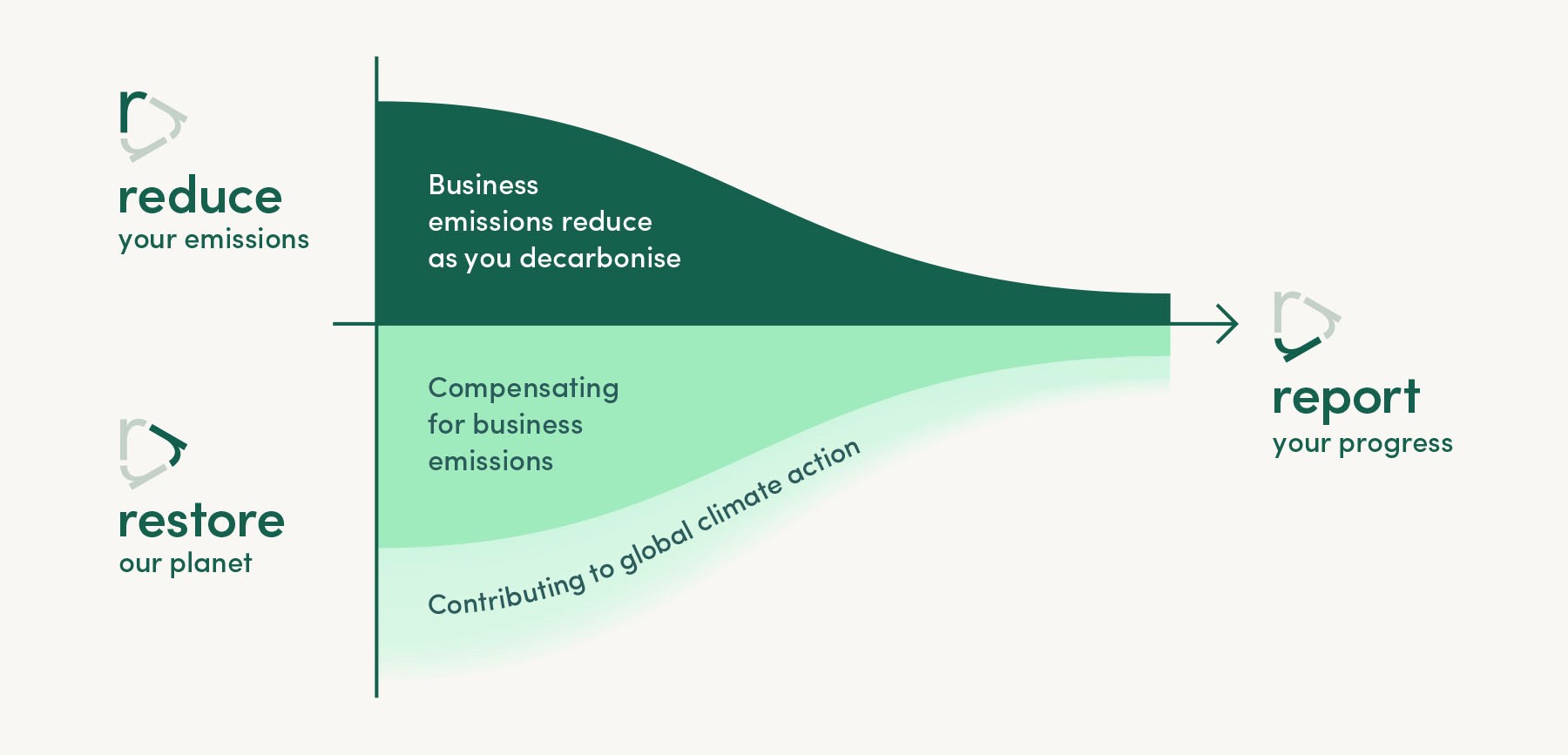
Together, these three pillars form a complete corporate climate strategy. Not a box-ticking exercise, not a one-off purchase, but a continuous programme with independently verifiable progress at every stage.

The 3Rs Certification Standard is a practical, SBTi-aligned net zero certification for mid-market and large businesses. It confirms that your organisation is taking a structured, measurable approach to its climate responsibilities across three core pillars:

  • Reduce - measuring and cutting emissions across your operations and value chain

  • Restore - funding verified, high-integrity climate solutions beyond your own footprint

  • Report - communicating progress transparently to the stakeholders who need to see it

Together, these three pillars form a complete corporate climate strategy. Not a box-ticking exercise, not a one-off purchase, but a continuous programme with independently verifiable progress at every stage.

What makes a credible net zero certification standard?

Not all net zero frameworks are equal. At Ecologi, we've built the 3Rs Standard around the global benchmarks that regulators, investors, and procurement teams already recognise:

That alignment matters for two reasons. First, the work your organisation does toward 3Rs certification isn't wasted effort if you later pursue a full SBTi submission. Second, your climate claims hold up to external scrutiny because they're built on the same foundations that all serious programmes use.

SBTi momentum is growing. But it's not the right fit for every business yet.

The numbers are hard to argue with. According to the SBTi Trend Tracker 2025, corporate climate target-setting grew by 40% last year. By January 2026, more than 10,000 companies globally had validated science-based targets, with over 2,800 new companies validated in 2025 alone.

That momentum is genuinely encouraging. It shows that science-aligned climate action is moving from niche commitment to mainstream expectation.

But for many mid-market and larger businesses, a full SBTi submission still isn't practical right now. The reasons are familiar to anyone who has explored it:

  • The process is resource-intensive. SBTi validation requires robust Scope 1, 2 and full material Scope 3 data, often across complex supply chains, before a target can even be submitted

  • The timeline is long. From starting emissions measurement to achieving validated targets, the process typically takes 12 to 24 months or more

  • The internal capability gap. Many organisations don't yet have the in-house expertise or dedicated sustainability resource to navigate the submission process without significant external support

None of this makes SBTi the wrong goal. It makes it a destination that requires a structured pathway to reach. That's exactly what the 3Rs Certification Standard provides: a credible, independently verified starting point, built on the same scientific foundations as SBTi, without requiring full validation readiness on day one.

For businesses serious about climate leadership, it's not a question of 3Rs or SBTi. It's 3Rs, then SBTi when it makes sense for your business.

Not all net zero frameworks are equal. At Ecologi, we've built the 3Rs Standard around the global benchmarks that regulators, investors, and procurement teams already recognise:

That alignment matters for two reasons. First, the work your organisation does toward 3Rs certification isn't wasted effort if you later pursue a full SBTi submission. Second, your climate claims hold up to external scrutiny because they're built on the same foundations that all serious programmes use.

SBTi momentum is growing. But it's not the right fit for every business yet.

The numbers are hard to argue with. According to the SBTi Trend Tracker 2025, corporate climate target-setting grew by 40% last year. By January 2026, more than 10,000 companies globally had validated science-based targets, with over 2,800 new companies validated in 2025 alone.

That momentum is genuinely encouraging. It shows that science-aligned climate action is moving from niche commitment to mainstream expectation.

But for many mid-market and larger businesses, a full SBTi submission still isn't practical right now. The reasons are familiar to anyone who has explored it:

  • The process is resource-intensive. SBTi validation requires robust Scope 1, 2 and full material Scope 3 data, often across complex supply chains, before a target can even be submitted

  • The timeline is long. From starting emissions measurement to achieving validated targets, the process typically takes 12 to 24 months or more

  • The internal capability gap. Many organisations don't yet have the in-house expertise or dedicated sustainability resource to navigate the submission process without significant external support

None of this makes SBTi the wrong goal. It makes it a destination that requires a structured pathway to reach. That's exactly what the 3Rs Certification Standard provides: a credible, independently verified starting point, built on the same scientific foundations as SBTi, without requiring full validation readiness on day one.

For businesses serious about climate leadership, it's not a question of 3Rs or SBTi. It's 3Rs, then SBTi when it makes sense for your business.

Why net zero certification matters commercially

Independent certification does something that internal commitments alone cannot: it makes your climate claims defensible.

Customers, investors, procurement teams, and regulators are scrutinising the climate credentials of the businesses they work with more closely than ever. Certification grounded in recognised global standards gives them the assurance they need, and gives your business the commercial protection it needs.

Specifically, the 3Rs Certification helps your business:

  • Build stakeholder trust by demonstrating that climate claims are backed by third-party verification, not just internal reporting

  • Win contracts and tenders by satisfying procurement RFPs, PPN 006 requirements, and social value criteria now standard in many sectors

  • Differentiate in competitive markets with a clear, recognisable signal of climate leadership

  • Align internal teams around a common language and structure that spans finance, operations, procurement, and strategy

  • Progress toward SBTi validation without the immediate cost or complexity of a full submission

Independent certification does something that internal commitments alone cannot: it makes your climate claims defensible.

Customers, investors, procurement teams, and regulators are scrutinising the climate credentials of the businesses they work with more closely than ever. Certification grounded in recognised global standards gives them the assurance they need, and gives your business the commercial protection it needs.

Specifically, the 3Rs Certification helps your business:

  • Build stakeholder trust by demonstrating that climate claims are backed by third-party verification, not just internal reporting

  • Win contracts and tenders by satisfying procurement RFPs, PPN 006 requirements, and social value criteria now standard in many sectors

  • Differentiate in competitive markets with a clear, recognisable signal of climate leadership

  • Align internal teams around a common language and structure that spans finance, operations, procurement, and strategy

  • Progress toward SBTi validation without the immediate cost or complexity of a full submission

How the 3Rs Standard aligns with SBTi certification

A common question: is the 3Rs Standard the same as SBTi certification?

No, but it's deliberately compatible with it. The 3Rs Standard is designed as a practical, lower-complexity entry point that keeps the door open to a full SBTi submission when your organisation is ready. The measurement methodology, target-setting approach, and reporting requirements are all structured to be SBTi-compatible from day one, so if you decide to pursue formal SBTi validation later, the groundwork is already done.

For a deeper look at what SBTi requires, our Science Based Targets guide and SBTi explainer blog cover everything you need to know.

A common question: is the 3Rs Standard the same as SBTi certification?

No, but it's deliberately compatible with it. The 3Rs Standard is designed as a practical, lower-complexity entry point that keeps the door open to a full SBTi submission when your organisation is ready. The measurement methodology, target-setting approach, and reporting requirements are all structured to be SBTi-compatible from day one, so if you decide to pursue formal SBTi validation later, the groundwork is already done.

For a deeper look at what SBTi requires, our Science Based Targets guide and SBTi explainer blog cover everything you need to know.

The Progressive Pathway: four levels of climate maturity

One of the most important design choices in the 3Rs Standard is that it meets your business where it is.

Rather than applying a single threshold that your organisation either passes or fails, certification is structured around four levels of maturity. Each level reflects increasing ambition across Reduce, Restore, and Report, so progress is always visible, always measurable, and always credible.

Level 1: Committed

The starting point. Your business begins measuring and reporting on its Scope 1, 2, and limited Scope 3 emissions, receives third-party review for the carbon footprint, sets science-aligned near-term reduction targets, and funds at least one verified climate project covering a minimum of 10% of measured emissions. You’ve also communicated your achievement with employees and/or customers.

Level 2: Advanced

Your organisation expands measurement and reporting to cover all material Scope 3 categories across multiple reporting years, achieves third-party independent limited assurance, sets science-aligned net-zero targets, and demonstrates progress against near-term reduction goals. At this level, businesses also set an internal carbon price of £20 per tonne to build a climate action budget aligned to their Scope 1 and 2 carbon footprint. You’ve also communicated your achievement with employees, customers and/or suppliers.
Level 3: Leader

Your organisation has measured and reported its carbon footprint across all scopes for four or more years, published a Climate Transition Plan, demonstrated progress against near-term targets at SBTi minimum ambition and applied an internal carbon price of at least £41.84 per tonne across all Scope emissions to build a climate action budget that is then applied to 50% carbon avoidance and removals and 50% towards nature restoration. At this level, your organisation actively advocates for climate action across employees, customers, suppliers, investors, and communities.

Level 4: Net Zero

The final tier. Your organisation has achieved net-zero targets across all scopes, compensated for residual emissions with Durable Carbon Dioxide Removal credits, and publicly champions climate action to multiple audiences as well as understanding your contribution to the net-zero economy.
One of the most important design choices in the 3Rs Standard is that it meets your business where it is.

Rather than applying a single threshold that your organisation either passes or fails, certification is structured around four levels of maturity. Each level reflects increasing ambition across Reduce, Restore, and Report, so progress is always visible, always measurable, and always credible.

Level 1: Committed

The starting point. Your business begins measuring and reporting on its Scope 1, 2, and limited Scope 3 emissions, receives third-party review for the carbon footprint, sets science-aligned near-term reduction targets, and funds at least one verified climate project covering a minimum of 10% of measured emissions. You’ve also communicated your achievement with employees and/or customers.

Level 2: Advanced

Your organisation expands measurement and reporting to cover all material Scope 3 categories across multiple reporting years, achieves third-party independent limited assurance, sets science-aligned net-zero targets, and demonstrates progress against near-term reduction goals. At this level, businesses also set an internal carbon price of £20 per tonne to build a climate action budget aligned to their Scope 1 and 2 carbon footprint. You’ve also communicated your achievement with employees, customers and/or suppliers.

Level 3: Leader

Your organisation has measured and reported its carbon footprint across all scopes for four or more years, published a Climate Transition Plan, demonstrated progress against near-term targets at SBTi minimum ambition and applied an internal carbon price of at least £41.84 per tonne across all Scope emissions to build a climate action budget that is then applied to 50% carbon avoidance and removals and 50% towards nature restoration. At this level, your organisation actively advocates for climate action across employees, customers, suppliers, investors, and communities.

Level 4: Net Zero

The final tier. Your organisation has achieved net-zero targets across all scopes, compensated for residual emissions with Durable Carbon Dioxide Removal credits, and publicly champions climate action to multiple audiences as well as understanding your contribution to the net-zero economy.

Reduce: Measuring & reducing your full carbon footprint: Scope 1, 2 and 3
Scope 3 emissions reporting is where most organisations struggle, and where most of the ambition-action gap lives. Scope 3 covers indirect emissions across your entire value chain: supply chain, business travel, employee commuting, and the use and disposal of your products.

For certification at Advanced level and above, full material Scope 3 coverage is required. At Ecologi, our carbon measurement platform supports your business through this process using primary and spend-based data, aligned to the GHG Protocol.

For a practical walkthrough of the measurement process, our guide on how to measure and manage your corporate carbon footprint covers the methodology in full.

Scope 3 emissions reporting is where most organisations struggle, and where most of the ambition-action gap lives. Scope 3 covers indirect emissions across your entire value chain: supply chain, business travel, employee commuting, and the use and disposal of your products.

For certification at Advanced level and above, full material Scope 3 coverage is required. At Ecologi, our carbon measurement platform supports your business through this process using primary and spend-based data, aligned to the GHG Protocol.

For a practical walkthrough of the measurement process, our guide on how to measure and manage your corporate carbon footprint covers the methodology in full.

Restore: Going beyond: what is Beyond Value Chain Mitigation (BVCM)?
Even the most ambitious reduction strategies leave residual emissions in the near term. This is where Beyond Value Chain Mitigation (BVCM) comes in.

BVCM is the practice of funding verified climate solutions outside your own value chain: nature restoration, carbon avoidance, and carbon removal projects that contribute to global climate goals while your own emissions reductions are underway. The SBTi explicitly recommends BVCM as a complement to science-based targets, not a substitute for them.

In the 3Rs framework, BVCM sits within the Restore pillar. Best practice involves building a balanced portfolio that includes both carbon avoidance and carbon removal credits, alongside contributions to habitat restoration and other nature-based projects.

At Ecologi, every project in our portfolio is assessed through our Carbon Project Assessment Framework (CPAF) and Nature Project Assessment Framework (NPAF), drawing on leading registry standards and independent rating agencies. Every contribution is traceable, verified, and defensible.

For a full breakdown of the BVCM approach and how to choose the right strategy for your business, read our BVCM guide.

Even the most ambitious reduction strategies leave residual emissions in the near term. This is where Beyond Value Chain Mitigation (BVCM) comes in.

BVCM is the practice of funding verified climate solutions outside your own value chain: nature restoration, carbon avoidance, and carbon removal projects that contribute to global climate goals while your own emissions reductions are underway. The SBTi explicitly recommends BVCM as a complement to science-based targets, not a substitute for them.

In the 3Rs framework, BVCM sits within the Restore pillar. Best practice involves building a balanced portfolio that includes both carbon avoidance and carbon removal credits, alongside contributions to habitat restoration and other nature-based projects.

At Ecologi, every project in our portfolio is assessed through our Carbon Project Assessment Framework (CPAF) and Nature Project Assessment Framework (NPAF), drawing on leading registry standards and independent rating agencies. Every contribution is traceable, verified, and defensible.

For a full breakdown of the BVCM approach and how to choose the right strategy for your business, read our BVCM guide.

Reporting: transparency that holds up to scrutiny
Climate claims without evidence are a liability for greenwashing, not leadership.

The Report pillar ensures your organisation communicates its emissions, targets, and progress in a way that holds up to scrutiny from investors, regulators, and procurement teams. This means publishing emissions inventories, disclosing climate targets and strategies, and actively engaging stakeholders on climate action.

At Ecologi, our platform supports reporting across the frameworks that matter to your stakeholders:

  • SECR for large UK companies required to report energy and carbon annually

  • CSRD for organisations in scope of the EU's Corporate Sustainability Reporting Directive

  • PPN 006 for businesses tendering for UK government contracts

  • SBTi for organisations pursuing formal science-based target validation

Not sure which frameworks apply to your business? Our guide to UK corporate sustainability standards is the clearest starting point, and our carbon disclosure obligations guide helps you identify exactly what your business is required to report.

Climate claims without evidence are a liability for greenwashing, not leadership.

The Report pillar ensures your organisation communicates its emissions, targets, and progress in a way that holds up to scrutiny from investors, regulators, and procurement teams. This means publishing emissions inventories, disclosing climate targets and strategies, and actively engaging stakeholders on climate action.

At Ecologi, our platform supports reporting across the frameworks that matter to your stakeholders:

  • SECR for large UK companies required to report energy and carbon annually

  • CSRD for organisations in scope of the EU's Corporate Sustainability Reporting Directive

  • PPN 006 for businesses tendering for UK government contracts

  • SBTi for organisations pursuing formal science-based target validation

Not sure which frameworks apply to your business? Our guide to UK corporate sustainability standards is the clearest starting point, and our carbon disclosure obligations guide helps you identify exactly what your business is required to report.

What the certification process looks like

Certification involves three stages:

1. Measurement and documentation
Your business compiles and submits emissions data, reduction targets, and evidence of climate action at the relevant level.

2. Assessment and verification
Your submission is reviewed against the 3Rs certification criteria for the level you're targeting.

3. Recognition and communication
Certified businesses receive a certification badge and access to marketing assets through Ecologi's Business Communications Toolkit. Your business is also listed on Ecologi's 3Rs Business Certification page with a link to your public Ecologi profile, giving your climate credentials a publicly verifiable home.

Certification isn't static. Your organisation is expected to maintain and improve performance over time, progressing to higher levels as your climate strategy matures.

Apply now


What comes next?

The ambition-action gap in corporate climate strategy is real, and it isn't closing fast enough. Part of the problem is complexity: too many frameworks, too little clarity on what actually counts.

The 3Rs Certification Standard cuts through that. A clear, progressive, independently verified pathway from first measurement to net zero, built on the global standards that serious climate programmes are already aligned to. Whether your business is just beginning to understand its emissions or preparing for an SBTi submission, there's a level that reflects where you are, and a clear view of what comes next.

Explore the 3Rs Certification Standard and find your level →

Certification involves three stages:

1. Measurement and documentation
Your business compiles and submits emissions data, reduction targets, and evidence of climate action at the relevant level.

2. Assessment and verification
Your submission is reviewed against the 3Rs certification criteria for the level you're targeting.

3. Recognition and communication
Certified businesses receive a certification badge and access to marketing assets through Ecologi's Business Communications Toolkit. Your business is also listed on Ecologi's 3Rs Business Certification page with a link to your public Ecologi profile, giving your climate credentials a publicly verifiable home.

Certification isn't static. Your organisation is expected to maintain and improve performance over time, progressing to higher levels as your climate strategy matures.

Apply now


What comes next?

The ambition-action gap in corporate climate strategy is real, and it isn't closing fast enough. Part of the problem is complexity: too many frameworks, too little clarity on what actually counts.

The 3Rs Certification Standard cuts through that. A clear, progressive, independently verified pathway from first measurement to net zero, built on the global standards that serious climate programmes are already aligned to. Whether your business is just beginning to understand its emissions or preparing for an SBTi submission, there's a level that reflects where you are, and a clear view of what comes next.

Explore the 3Rs Certification Standard and find your level →

Frequently asked questions

What is 3Rs Certification?

3Rs Certification is a structured standard that recognises how your business is addressing its climate impact across three areas: reducing emissions, funding climate solutions, and reporting progress.

It assesses your approach against defined criteria and places you within a clear progression pathway, so your certification reflects your current level of maturity and ambition.

How is 3Rs Certification different from other climate certifications?

3Rs Certification is built around a progression model rather than a single threshold.

Instead of a one-off pass or fail, it shows:

  • where you are today

  • what you’ve achieved

  • what’s required to progress

It combines emissions reduction, climate funding and reporting into a single framework, aligned to recognised standards but designed for practical implementation.

Is 3Rs Certification aligned with SBTi?

Yes. The certification is designed to align with science-based approaches, including the Science Based Targets initiative (SBTi).

It supports:

  • emissions measurement in line with GHG Protocol

  • science-aligned target setting

  • progression towards net zero

It can also help prepare your organisation for SBTi validation, without requiring you to start there.

What are the certification levels?

There are four certification levels, reflecting increasing ambition and maturity:

  • Committed – establish your baseline and begin taking action

  • Advanced – expand coverage and strengthen targets and investment

  • Leader – demonstrate measurable reductions and structured climate investment

  • Net zero – achieve long-term targets and address residual emissions

Each level is time-bound and aligned with net zero pathways.

What do you need to achieve certification?

To achieve certification, your organisation must meet defined criteria across all three pillars:

  • Reduce – measure emissions, set targets and demonstrate progress

  • Restore – fund climate solutions in proportion to your emissions

  • Report – publish and communicate your climate data and actions

The exact requirements depend on the certification level and increase as you progress.

Is certification independently verified?

Certification is based on structured assessment against defined criteria, including requirements such as third-party validation or assurance of emissions data at different stages.

This ensures that certification reflects measurable action and transparent reporting, rather than self-declared claims.

How long does certification last?

Certification is time-bound and reflects your current position.

You are expected to:

  • maintain your performance

  • continue improving

  • progress to the next level over time

This ensures your certification remains relevant and up to date.

Can SMEs get 3Rs Certification?

Yes. The certification is designed to be practical and accessible, particularly for mid-market businesses and growing organisations.

It provides a structured pathway that allows you to start where you are and build over time, rather than requiring full maturity from the outset.

How does certification help with procurement and reporting?

Certification provides a clear, externally understandable signal of your climate approach.

It can support:

  • procurement requirements and RFP responses

  • stakeholder reporting and disclosures

  • investor and board communication

By structuring your climate strategy and demonstrating progress, it makes your position easier to understand and evaluate.

What do you receive when you are certified?

Certified businesses receive:

  • a certification level aligned to their progress

  • a certification badge and communication assets

  • inclusion in Ecologi’s certification listings

  • a clear pathway to progress to the next level

This helps you communicate your climate action consistently across your website, reporting and commercial materials.

How long does the certification process take?

Timelines vary depending on your current level of maturity and data readiness.

For businesses with existing emissions data and climate activity in place, the process can be relatively quick. For others, certification may form part of a broader programme to establish measurement, targets and reporting.

What is the difference between carbon neutral and net zero certification?

Carbon neutral typically means a business has offset its current emissions, often through carbon credits, without necessarily reducing them. Net zero requires deep, science-aligned emissions reductions across the full value chain, with only residual emissions addressed through high-quality carbon removal.

3Rs Certification is a net zero standard, not a carbon neutral one. The Progressive Pathway requires businesses to measure, reduce and report emissions in line with science-based targets, with climate funding playing a supporting rather than substituting role. This distinction matters increasingly to regulators, investors and procurement teams who are scrutinising environmental claims more closely.

How does 3Rs Certification compare to ISO 14064?

ISO 14064 is an international standard for greenhouse gas accounting and verification. It provides a framework for measuring and reporting emissions but does not include reduction targets, climate funding requirements or a progression pathway to net zero.

3Rs Certification builds on the same rigorous measurement principles as ISO 14064 and adds the full strategic layer: science-aligned targets, structured climate investment and transparent reporting. For businesses that want to go beyond accounting and demonstrate active progress toward net zero, 3Rs provides the complete framework.

How does 3Rs Certification compare to B Corp?

B Corp certification assesses overall business impact across governance, workers, community, environment and customers. It is broad by design and well recognised, but it is not a net zero or carbon certification. Environmental performance is one component of a wider scorecard.

3Rs Certification focuses specifically on climate action: measuring your carbon footprint, reducing emissions, funding climate solutions and reporting progress. The two are complementary. Many B Corps pursue 3Rs Certification to strengthen and evidence the environmental pillar of their B Corp assessment with a dedicated, independently verified climate standard.

How does 3Rs Certification compare to SBTi?

SBTi (Science Based Targets initiative) is the gold standard for corporate emissions reduction targets, but full validation is a significant undertaking. It requires substantial internal resource, a detailed submission process, and typically suits larger organisations with dedicated sustainability teams.

3Rs Certification is designed to be SBTi-compatible without requiring you to start there. It follows the same science-aligned methodology for emissions measurement and target setting, so businesses that achieve 3Rs certification are automatically prepared for SBTi validation if and when they need it. For mid-market businesses that want credible, structured climate action now, 3Rs is the practical starting point.

Frequently asked questions

What is 3Rs Certification?

3Rs Certification is a structured standard that recognises how your business is addressing its climate impact across three areas: reducing emissions, funding climate solutions, and reporting progress.

It assesses your approach against defined criteria and places you within a clear progression pathway, so your certification reflects your current level of maturity and ambition.

How is 3Rs Certification different from other climate certifications?

3Rs Certification is built around a progression model rather than a single threshold.

Instead of a one-off pass or fail, it shows:

  • where you are today

  • what you’ve achieved

  • what’s required to progress

It combines emissions reduction, climate funding and reporting into a single framework, aligned to recognised standards but designed for practical implementation.

Is 3Rs Certification aligned with SBTi?

Yes. The certification is designed to align with science-based approaches, including the Science Based Targets initiative (SBTi).

It supports:

  • emissions measurement in line with GHG Protocol

  • science-aligned target setting

  • progression towards net zero

It can also help prepare your organisation for SBTi validation, without requiring you to start there.

What are the certification levels?

There are four certification levels, reflecting increasing ambition and maturity:

  • Committed – establish your baseline and begin taking action

  • Advanced – expand coverage and strengthen targets and investment

  • Leader – demonstrate measurable reductions and structured climate investment

  • Net zero – achieve long-term targets and address residual emissions

Each level is time-bound and aligned with net zero pathways.

What do you need to achieve certification?

To achieve certification, your organisation must meet defined criteria across all three pillars:

  • Reduce – measure emissions, set targets and demonstrate progress

  • Restore – fund climate solutions in proportion to your emissions

  • Report – publish and communicate your climate data and actions

The exact requirements depend on the certification level and increase as you progress.

Is certification independently verified?

Certification is based on structured assessment against defined criteria, including requirements such as third-party validation or assurance of emissions data at different stages.

This ensures that certification reflects measurable action and transparent reporting, rather than self-declared claims.

How long does certification last?

Certification is time-bound and reflects your current position.

You are expected to:

  • maintain your performance

  • continue improving

  • progress to the next level over time

This ensures your certification remains relevant and up to date.

Can SMEs get 3Rs Certification?

Yes. The certification is designed to be practical and accessible, particularly for mid-market businesses and growing organisations.

It provides a structured pathway that allows you to start where you are and build over time, rather than requiring full maturity from the outset.

How does certification help with procurement and reporting?

Certification provides a clear, externally understandable signal of your climate approach.

It can support:

  • procurement requirements and RFP responses

  • stakeholder reporting and disclosures

  • investor and board communication

By structuring your climate strategy and demonstrating progress, it makes your position easier to understand and evaluate.

What do you receive when you are certified?

Certified businesses receive:

  • a certification level aligned to their progress

  • a certification badge and communication assets

  • inclusion in Ecologi’s certification listings

  • a clear pathway to progress to the next level

This helps you communicate your climate action consistently across your website, reporting and commercial materials.

How long does the certification process take?

Timelines vary depending on your current level of maturity and data readiness.

For businesses with existing emissions data and climate activity in place, the process can be relatively quick. For others, certification may form part of a broader programme to establish measurement, targets and reporting.

What is the difference between carbon neutral and net zero certification?

Carbon neutral typically means a business has offset its current emissions, often through carbon credits, without necessarily reducing them. Net zero requires deep, science-aligned emissions reductions across the full value chain, with only residual emissions addressed through high-quality carbon removal.

3Rs Certification is a net zero standard, not a carbon neutral one. The Progressive Pathway requires businesses to measure, reduce and report emissions in line with science-based targets, with climate funding playing a supporting rather than substituting role. This distinction matters increasingly to regulators, investors and procurement teams who are scrutinising environmental claims more closely.

How does 3Rs Certification compare to ISO 14064?

ISO 14064 is an international standard for greenhouse gas accounting and verification. It provides a framework for measuring and reporting emissions but does not include reduction targets, climate funding requirements or a progression pathway to net zero.

3Rs Certification builds on the same rigorous measurement principles as ISO 14064 and adds the full strategic layer: science-aligned targets, structured climate investment and transparent reporting. For businesses that want to go beyond accounting and demonstrate active progress toward net zero, 3Rs provides the complete framework.

How does 3Rs Certification compare to B Corp?

B Corp certification assesses overall business impact across governance, workers, community, environment and customers. It is broad by design and well recognised, but it is not a net zero or carbon certification. Environmental performance is one component of a wider scorecard.

3Rs Certification focuses specifically on climate action: measuring your carbon footprint, reducing emissions, funding climate solutions and reporting progress. The two are complementary. Many B Corps pursue 3Rs Certification to strengthen and evidence the environmental pillar of their B Corp assessment with a dedicated, independently verified climate standard.

How does 3Rs Certification compare to SBTi?

SBTi (Science Based Targets initiative) is the gold standard for corporate emissions reduction targets, but full validation is a significant undertaking. It requires substantial internal resource, a detailed submission process, and typically suits larger organisations with dedicated sustainability teams.

3Rs Certification is designed to be SBTi-compatible without requiring you to start there. It follows the same science-aligned methodology for emissions measurement and target setting, so businesses that achieve 3Rs certification are automatically prepared for SBTi validation if and when they need it. For mid-market businesses that want credible, structured climate action now, 3Rs is the practical starting point.

Is your business ready
to take climate action?

If this article has inspired your business to start its climate journey, talk to our team today.

Is your business ready
to take climate action?

If this article has inspired your business to start its climate journey, talk to our team today.

Is your business ready
to take climate action?

If this article has inspired your business to start its climate journey, talk to our team today.