

By
Director of Climate Science & Impact
4 min read


The new draft ISO Standard for Net Zero Aligned Organisations is currently open for consultation until 10th August 2026.
Here’s our run-down of what the ISO Standard is, and how we have responded to the consultation.
What is ISO 14060?
ISO 14060 Net Zero Aligned Organizations is a new Standard by the International Organization for Standardization (ISO) which defines organisational net-zero and sets requirements for credibly claiming, certifying, and maintaining it. It builds on ISO's 2022 Net Zero Guidelines and is designed to be independently verifiable – meaning a certification body can audit a company against it.
The standard is structured across clauses covering leadership commitment, establishing boundaries, greenhouse gas (GHG) inventory quantification, climate transition planning, target and pathway setting, net-zero action, counterbalancing residual emissions, monitoring and adjustment, reporting, and validation – with net-zero claims sitting on top of all of it.
How do ISO Standards work?
Unlike for example the SBTi, ISO itself doesn’t certify anyone. Standards like this one are drafted by technical committees of industry experts, coordinated through each country's national standards body, then agreed by consensus and voted on nationally before publication.
In the UK, the national standards body is the BSI (the British Standards Institution). It represents UK interests during drafting and is funded and supported by the Department for Business and Trade, then adopts the finished standard as a British Standard.
Certification against ISO Standards is a separate step, carried out by qualified, independent bodies accredited by UKAS.
Transition planning: the backbone of the ISO Standard
Under the draft ISO 14060, the most important component of compliance is to produce and publish a transition plan. It is the backbone requirement that everything else derives from: the plan to mitigate the company’s quantified greenhouse gas emissions.
The draft Standard requires a documented transition plan that must be updated at least every five years, or sooner if circumstances change materially.
An ISO compliant transition plan has to include:
A net-zero target and interim milestones, with the first no more than five years away.
An assessment of climate risks and opportunities.
How the organisation approaches policy engagement and advocacy.
The transition plan also must be supported and endorsed by ‘top management’ – the highest decision-making leaders within the business (usually the board). Top management also has specific obligations under the Standard, including providing resources to meet the transition plan, and advocating for policies and regulations consistent with the Paris Agreement.
The Standard has a bias to action: it explicitly states that organisations must not delay action because their data is incomplete. Businesses are expected to act on reasonable estimates while improving measurement quality over time.
Robust target setting for scopes 1 and 2
The standard treats direct and energy-related emissions differently, and both come with specific rules:
Scope 1: organisations must set a GHG budget – a cumulative emissions ceiling between the base year and target year – using peer-reviewed allocation methods.
Scope 2: long-term targets must use the location-based accounting approach. A market-based approach reflecting contracts like PPAs or renewable energy certificates is only allowed for interim targets tied specifically to low-carbon energy procurement, not for the long-term target itself.
The inclusion of carbon budgets within scope 1 targets is especially interesting.
Your actual cumulative emissions across the period have to stay at or below the budget, not just hit a single target number by the end. This is to ensure that the overall direct emissions from the business are small - since two businesses that both achieve a 90% reduction by the net-zero date can produce dramatically different amounts of emissions along the way.
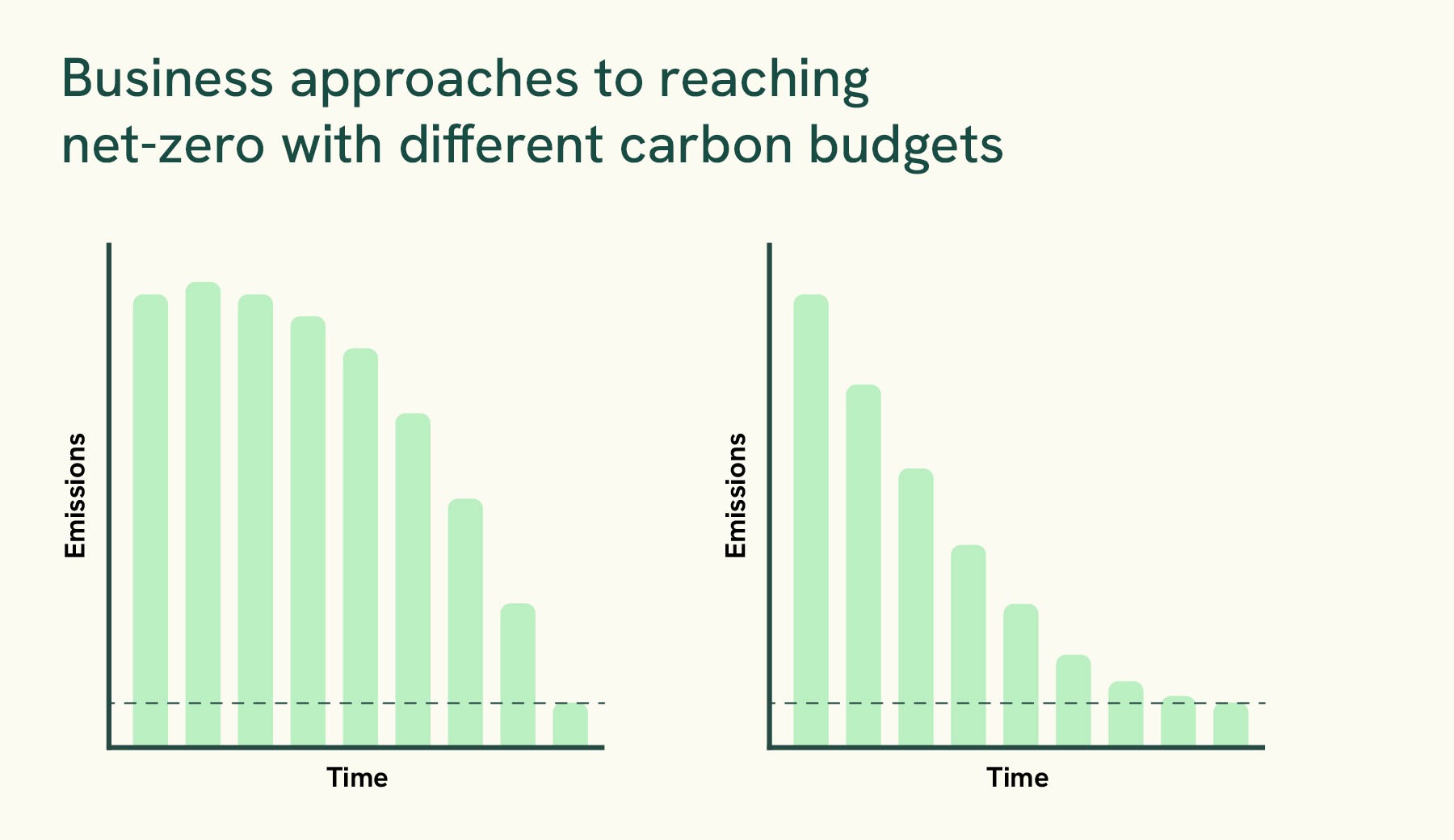
Chart: illustrative diagram showing how two businesses could both achieve net-zero at the same time, but take pathways which deliver very different overall greenhouse gas emissions along the way. The business on the left continued producing high emissions for several years before making significant cuts very late, whereas the business on the right made deep emissions cuts early. Both businesses achieve net-zero at the same time – but the business on the right burned through a significantly lower carbon budget along the way.
And on scope 2, the Standard rules out a common shortcut: buying renewable energy certificates and considering scope 2 ‘solved’ for the long-term. Under ISO 14060, doing so would only count toward interim progress – and the long-term target for scope 2 would require reductions in the actual carbon intensity of the grid your electricity is coming from. This gives businesses a real stake in decarbonising the overall grid mix where they are located.
Establishing significant categories for scope 3 target setting
The draft Standard applies a two-factor test to work out whether specific categories of scope 3 emissions are material:
the magnitude of the emissions (as a percentage of total), and
the organisation's influence over them.
‘Secondary criteria’ are also in play, to help differentiate between categories of scope 3 emissions which could be considered significant in one of the primary criteria but not in the other.
Lower influence | Higher influence | |
|---|---|---|
Higher magnitude | Significant if one secondary criterion applies | Significant |
Lower magnitude | Optional (consider secondary criteria) | Significant if one secondary criterion applies |
Secondary criteria for determining materiality include:
Risk and opportunity: if the scope 3 emissions expose the organisation to physical and transition risks or abating them creates new opportunities;
Sector-specific guidance: if the scope 3 emissions are deemed significant in guidance relevant to the sector the business is in;
Outsourcing: if the scope 3 emissions result from outsourced activities; and
Employee generated: if the scope 3 emissions come from employee emissions that the organisation can influence (e.g. business travel, commuting).
Setting scope 3 targets out in this way will help businesses to hold themselves accountable for the categories of emissions that they reasonably should be: prioritising those that are both large sources of emissions and within their control, and working downwards from there.
Carbon credits: what's allowed and what isn't
In the draft ISO 14060 Standard carbon credits have a role, but it's narrow and subject to significant guardrails:
Contribution to global net zero – credits purchased here sit outside an organisation's own targets. They're an additional contribution to the wider global effort, not a mechanism for closing the gap on your own reduction pathway (this is similar to the SBTi’s Ongoing Emissions Responsibility).
Remedial action – if an organisation falls short of an interim target, credits are one of the specified remedial options available to help maintain or regain a net zero claim, alongside a corrective action plan.
Addressing historical emissions – framed as a high-ambition activity, this lets organisations use credits to account for emissions accumulated before their base year.
Counterbalancing residual emissions at net-zero – the only point at which credits do the "final mile" work, and restricted to long-lived removals only, in a balanced portfolio.
There is further prescription in the Standard regarding the final use-ase, counterbalancing.
This is equivalent to what the SBTi calls ‘neutralisation’. Once an organisation has reduced its emissions as far as technically and economically feasible, whatever is left ("residual emissions") must be counterbalanced with genuine carbon dioxide removals.
The ’balanced portfolio’ should combine:
Ex-post removal credits – delivered and retired within two years of issuance;
Advance off-take agreements – to help scale new removal technologies and secure future supply;
And projects within the portfolio should combine:
Technological removals – lower reversal risk, but higher delivery risk given the early stage of scale-up;
Nature-based removals – potentially higher reversal risk, but lower delivery risk and broader co-benefits for nature and people.
Organisations aren't required to use removal credits with corresponding adjustments (a mechanism that avoids double-counting against national climate targets), in a requirement that mirrors the one in the SBTi’s V2 Corporate Net-Zero Standard and the one in the Shared Principles of the Coalition to Grow Carbon Markets.
There's also a related, separate requirement to build a portfolio of climate finance: organisations must allocate funding for climate action and disclose its value relative to their remaining annual emissions, often via an internal carbon fee, aiming to cover 100% of remaining emissions. Again this mirrors the OER module of the new SBTi V2.
Making net-zero claims
ISO 14060 treats "net-zero" as a staged claim, where businesses can claim alignment with one of four stages and must exhibit certain behaviours to retain the claim.
Net-zero aspiration: no prior net-zero or carbon neutral target required. Two years to publish a GHG inventory, set a target and date, and develop a transition plan – with a one-year extension if remedial action is needed – or the claim has to be dropped.
Net-zero aligned transition plan: GHG inventory, transition plan and first interim target (within five years) are in place. Valid for up to five years, during which the organisation implements the first phase of the plan and reports on progress after two and a half years.
Net-zero aligned progress: interim targets and milestones are actually being met. This claim is renewed every five years, based on continuing to hit each next set of targets.
Net-zero achievement: net-zero reached, with a plan to maintain it, and maintained through annual demonstration of net-zero status.
Exemptions for SMEs
ISO 14060 gives smaller organisations some breathing room, mainly around Scope 3. SMEs can exclude Scope 3 categories from their inventory where they're not significant, provided they disclose the reasoning, and they can exclude categories that don’t apply to them. Spend-based emissions factors can be used as a starting point. Intensity targets can be used for interim targets.
What SMEs don't get is a lower bar on rigour – exclusions have to be justified and disclosed, not just assumed, and the standard's baseline principle still applies: don't wait for perfect data before acting.
Should you act now?
The ISO Net Zero Standard is still in draft, open for consultation until 10 August 2026, with final publication expected in late 2026 or early 2027. That gives businesses a genuine window to prepare rather than react. Reach out to our experts for support.