Blog

From Risk to Reward: How UK businesses are building resilience to deliver long-term value

Climate Leadership

Blog

From Risk to Reward: How UK businesses are building resilience to deliver long-term value

Climate Leadership

From Risk to Reward: How UK businesses are building resilience to deliver long-term value
Sam Jackson

Director of Climate Science & Impact

8 min read

From Risk to Reward: How UK businesses are building resilience to deliver long-term value

For the past few years, the narrative around corporate sustainability has been muddied. Talk of an ESG backlash and a fractured political consensus has fuelled the perception that climate action is sliding down the corporate agenda. 

Our 2026 Climate Commitments Report, conducted with 1,600 UK business leaders across 28 sectors, tells a very different story.

Climate impacts are visible on balance sheets. Businesses are responding with investment, strategy, and structural change. Those acting decisively are reaping measurable commercial rewards. Here is what the data shows.

Download the full report

You can download the PDF of the full findings from Ecologi's 2026 Climate Commitments Report here.

You can download the PDF of the full findings from Ecologi's 2026 Climate Commitments Report here.

Risk: the climate-immune business no longer exists

The most striking finding in this year's survey is the widespread exposure to climate disruption and how it's impacting the bottom line. Nearly nine in ten UK businesses report having experienced at least one direct climate-related impact in the past two years.

That disruption is translating directly into financial damage. Some 70% of UK businesses report losing more than 1% of annual turnover to climate-related impacts in the past year.

For 40% of all businesses surveyed, that loss has reached 6% or more of annual turnover, a figure that threatens the fundamental solvency of organisations operating on thin margins. 

Over a third of large companies (250-999 FTE) appear to carry disproportionate climate financial exposure, having placed themselves in the 6-10% of annual turnover impact bracket.
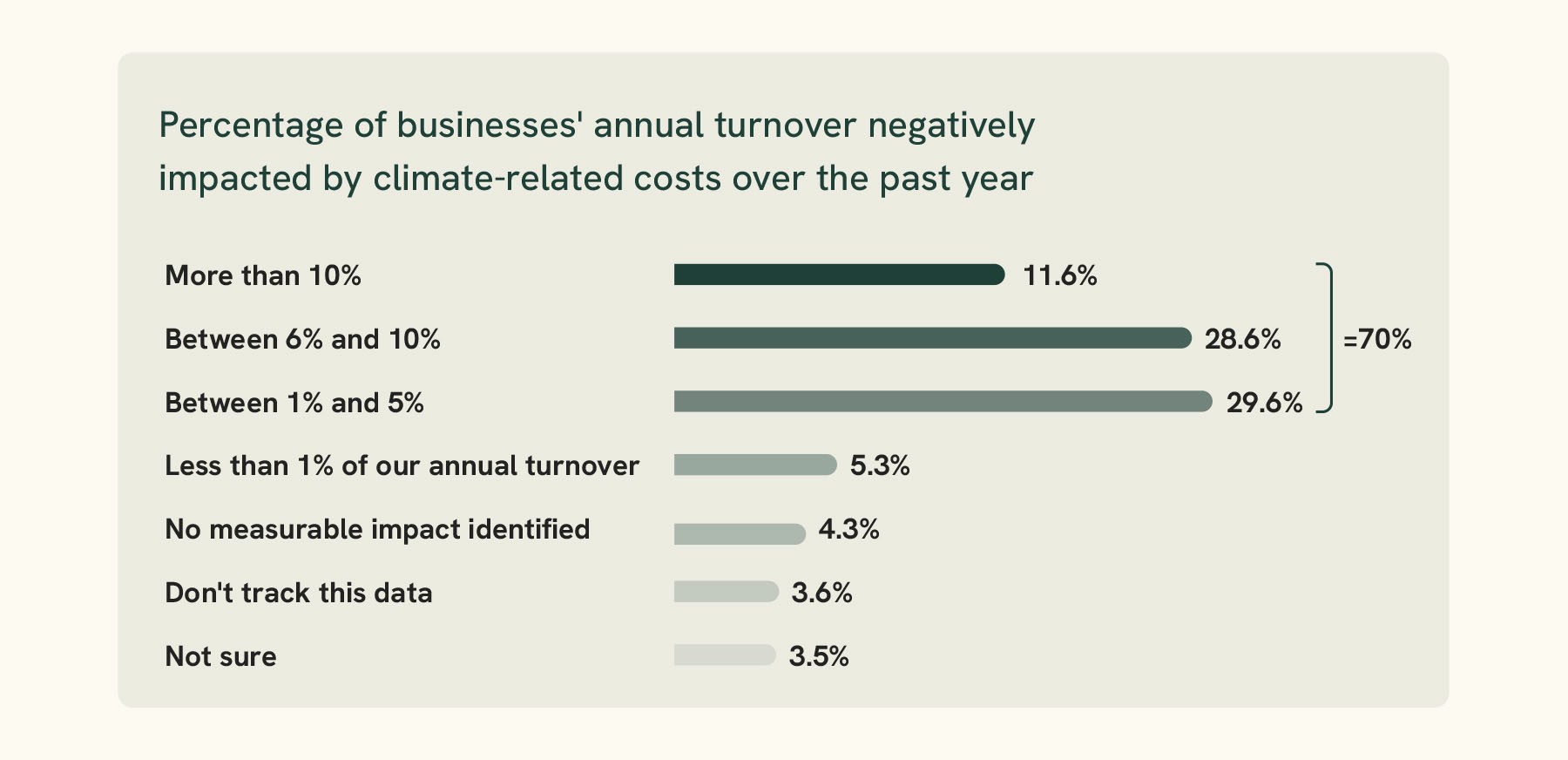
Percentage of annual turnover affected by climate impacts

Nearly a third of organisations (31%) are seeing higher running costs due to energy price spikes and resource shortages. Some 28% are paying more for raw materials, and 22% have experienced direct supply chain disruptions. On top of this, 20% of businesses are finding it harder or more expensive to secure insurance cover, and 20% report that customers are actively demanding more credible action on climate.

Put simply: climate change is no longer a future cost. It is a present-day business expense appearing on balance sheets across every sector.
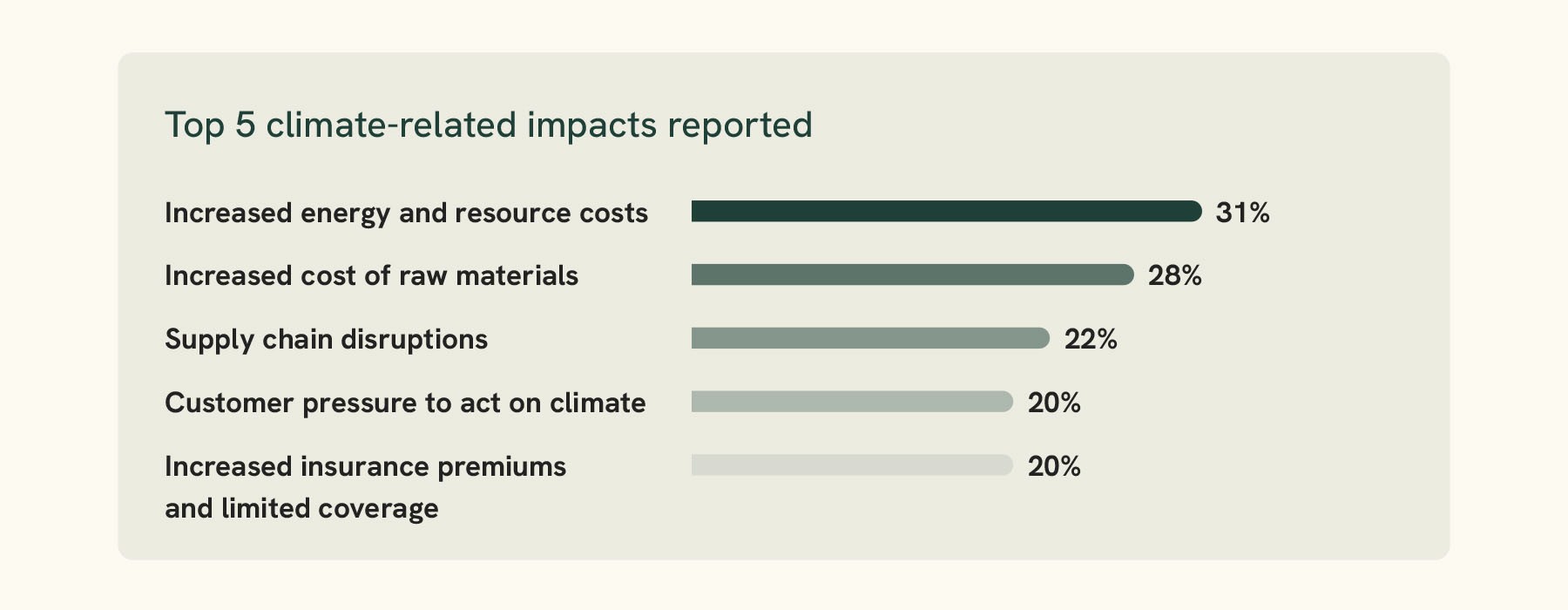
Top 5 climate-related impacts reported

A growing nature blind spot

There is also a deeper and more troubling risk that this year's data exposes. Only 58% of UK businesses acknowledge that their operations depend on nature and biodiversity to function. That figure has dropped by 9 percentage points since 2025. Businesses are feeling the financial consequences of ecological breakdown, from supply chain disruptions to resource scarcity, without connecting those consequences to their root cause. 

One third of organisations fail to recognise their reliance on natural systems such as water cycles, soil stability, and pollination: the very foundations of supply chain continuity and physical asset value. This is what we call the nature blind spot, and it is getting wider at exactly the wrong time.

The most striking finding in this year's survey is the widespread exposure to climate disruption and how it's impacting the bottom line. Nearly nine in ten UK businesses report having experienced at least one direct climate-related impact in the past two years.

That disruption is translating directly into financial damage. Some 70% of UK businesses report losing more than 1% of annual turnover to climate-related impacts in the past year.

For 40% of all businesses surveyed, that loss has reached 6% or more of annual turnover, a figure that threatens the fundamental solvency of organisations operating on thin margins. 

Over a third of large companies (250-999 FTE) appear to carry disproportionate climate financial exposure, having placed themselves in the 6-10% of annual turnover impact bracket.

Percentage of annual turnover affected by climate impacts

Nearly a third of organisations (31%) are seeing higher running costs due to energy price spikes and resource shortages. Some 28% are paying more for raw materials, and 22% have experienced direct supply chain disruptions. On top of this, 20% of businesses are finding it harder or more expensive to secure insurance cover, and 20% report that customers are actively demanding more credible action on climate.

Put simply: climate change is no longer a future cost. It is a present-day business expense appearing on balance sheets across every sector.

Top 5 climate-related impacts reported

A growing nature blind spot

There is also a deeper and more troubling risk that this year's data exposes. Only 58% of UK businesses acknowledge that their operations depend on nature and biodiversity to function. That figure has dropped by 9 percentage points since 2025. Businesses are feeling the financial consequences of ecological breakdown, from supply chain disruptions to resource scarcity, without connecting those consequences to their root cause. 

One third of organisations fail to recognise their reliance on natural systems such as water cycles, soil stability, and pollination: the very foundations of supply chain continuity and physical asset value. This is what we call the nature blind spot, and it is getting wider at exactly the wrong time.

Resilience: sustainability has become a defensive financial strategy

In response to mounting climate pressure, UK businesses are transforming sustainability from a compliance exercise into a practical shield for future revenue. Some 83% of businesses now agree that taking measurable steps toward net zero is essential to protect future revenue and operational resilience. 

The operational shift is clear. Some 61% of businesses have adopted a formal, structured approach to climate resilience, embedding it into their sustainability plans or deploying standalone strategies. Over the past two years, 23% of organisations have invested in energy-efficient infrastructure, 21% have installed on-site renewables, and significant proportions have implemented physical upgrades to protect assets against extreme weather, electrified operations, or deployed local nature-based solutions.
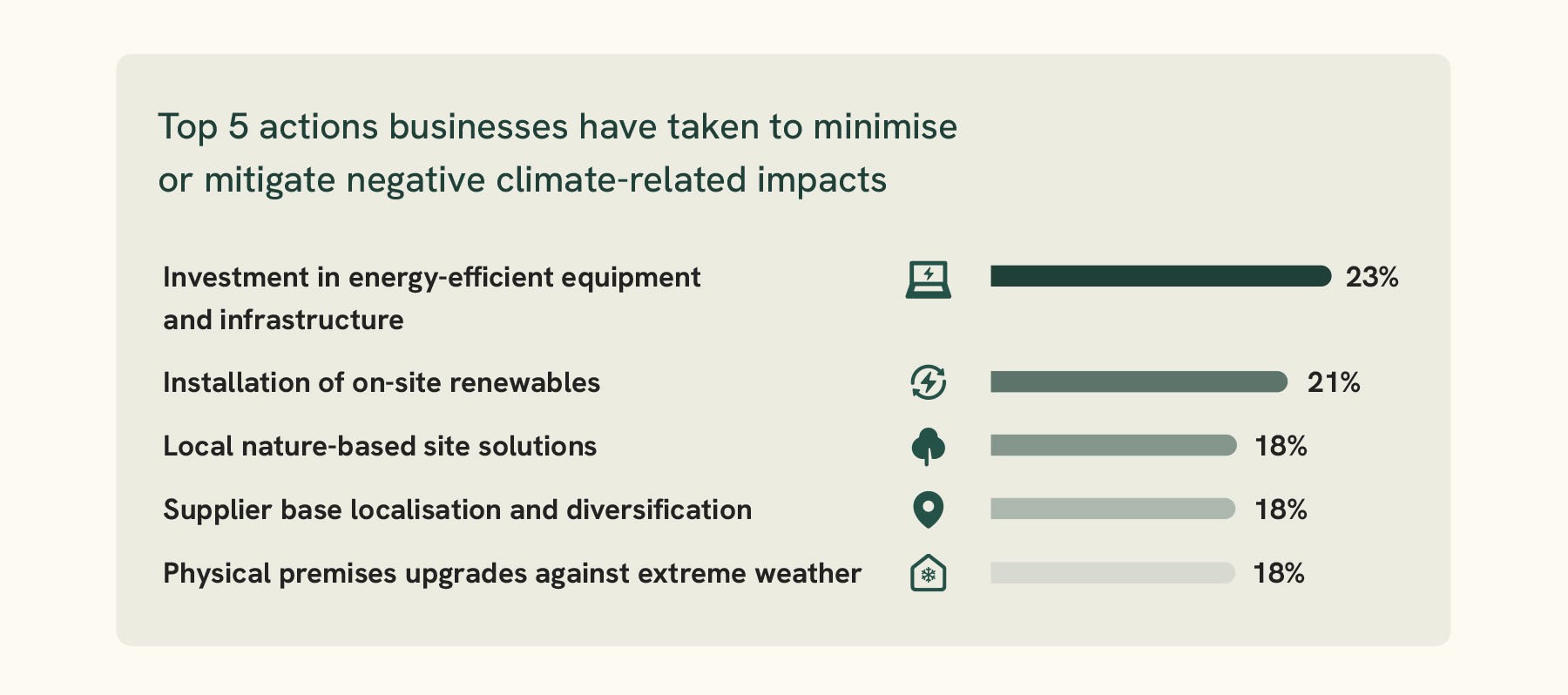
Top 5 actions businesses have taken to mitigate climate impacts

Carbon measurement has also become business as usual. With 42% of businesses measuring consistently and 35% having started in the last year, 77% of the UK market is now actively tracking its emissions.

A combined 84% of those who measure are publicly disclosing their footprint, signalling that transparency is rapidly becoming an operational default rather than a differentiator.

Persistent financial and operational barriers

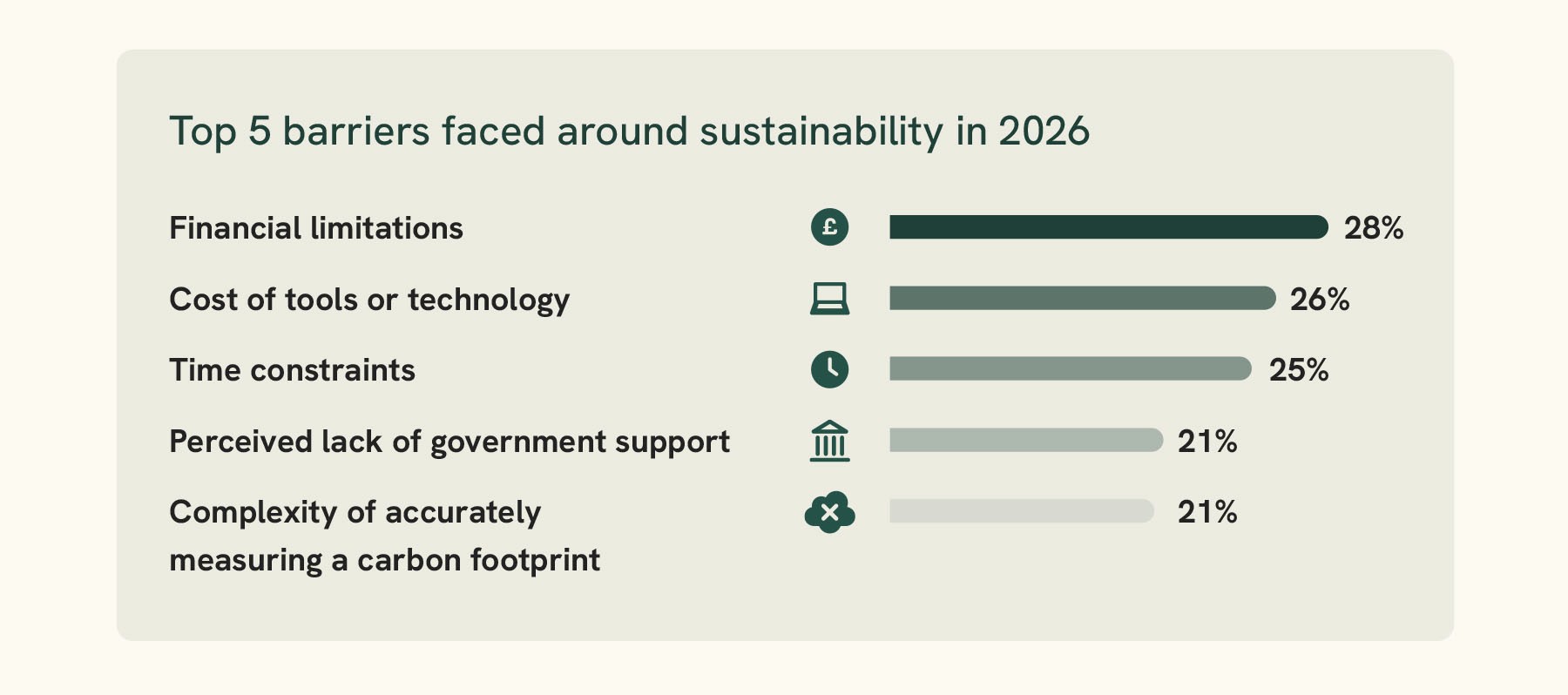
However, progress is uneven, and barriers remain stubbornly consistent. Financial constraints (28%), the high cost of tools and technology (26%), and time pressures (25%) continue to slow momentum year on year. For many businesses, particularly SMEs, the belief in the business case for net zero is there but the structures and frameworks to act on it are not.
Top 5 barriers faced around sustainability in 2026

The nature blind spot compounds this challenge significantly. Businesses that focus exclusively on carbon reduction are building resilience on incomplete foundations. Addressing nature-related risks alongside climate risks is not an optional extra. It is an essential component of a credible and durable resilience strategy.

In response to mounting climate pressure, UK businesses are transforming sustainability from a compliance exercise into a practical shield for future revenue. Some 83% of businesses now agree that taking measurable steps toward net zero is essential to protect future revenue and operational resilience. 

The operational shift is clear. Some 61% of businesses have adopted a formal, structured approach to climate resilience, embedding it into their sustainability plans or deploying standalone strategies. Over the past two years, 23% of organisations have invested in energy-efficient infrastructure, 21% have installed on-site renewables, and significant proportions have implemented physical upgrades to protect assets against extreme weather, electrified operations, or deployed local nature-based solutions.

Top 5 actions businesses have taken to mitigate climate impacts

Carbon measurement has also become business as usual. With 42% of businesses measuring consistently and 35% having started in the last year, 77% of the UK market is now actively tracking its emissions.

A combined 84% of those who measure are publicly disclosing their footprint, signalling that transparency is rapidly becoming an operational default rather than a differentiator.

Persistent financial and operational barriers

However, progress is uneven, and barriers remain stubbornly consistent. Financial constraints (28%), the high cost of tools and technology (26%), and time pressures (25%) continue to slow momentum year on year. For many businesses, particularly SMEs, the belief in the business case for net zero is there but the structures and frameworks to act on it are not.

Top 5 barriers faced around sustainability in 2026

The nature blind spot compounds this challenge significantly. Businesses that focus exclusively on carbon reduction are building resilience on incomplete foundations. Addressing nature-related risks alongside climate risks is not an optional extra. It is an essential component of a credible and durable resilience strategy.

Reward: purpose and profit have converged

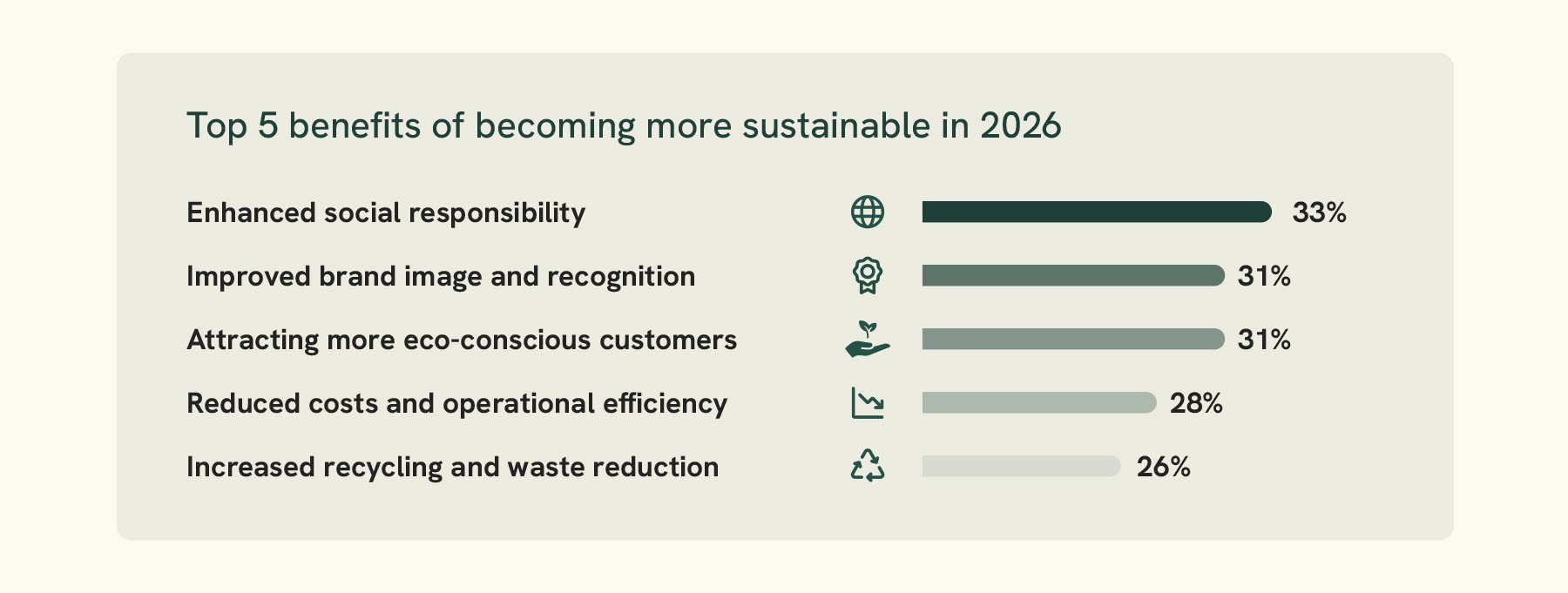
When asked to identify the specific benefits they experienced, the top five findings from 2026 tell a clear story. Enhanced social responsibility leads the way, cited by 33% of businesses, closely followed by improved brand image and recognition and attracting more eco-conscious customers, both at 31%. Reduced costs and improved operational efficiency come in at 28%, with increased circularity and waste reduction rounding out the top five at 26%.
Top 5 benefits of becoming more sustainable in 2026

The financial rewards of decarbonisation

The commercial case for climate action is no longer theoretical. Among the 74% of businesses actively reducing their emissions, nearly all report experiencing measurable commercial benefits. Across all 12 benefit categories measured in the survey, an average of 41% of those businesses reported uplifts greater than 16%, indicating moderate to significant gains.

The returns span every dimension of business performance:

Commercial benefits from climate action

The businesses seeing the strongest returns are not just reducing costs. They are growing revenue, winning customers, and pulling ahead of competitors. Enterprise companies (1,000+ FTE) see the strongest revenue impact, with 32.4% reporting significant uplift compared to 10.2% of SMEs. Mid-sized businesses (250-999 FTE), meanwhile, see the strongest returns in customer retention and staff recruitment, where sustainability credentials still serve as a genuine differentiator.


The commercial evolution of sustainability drivers

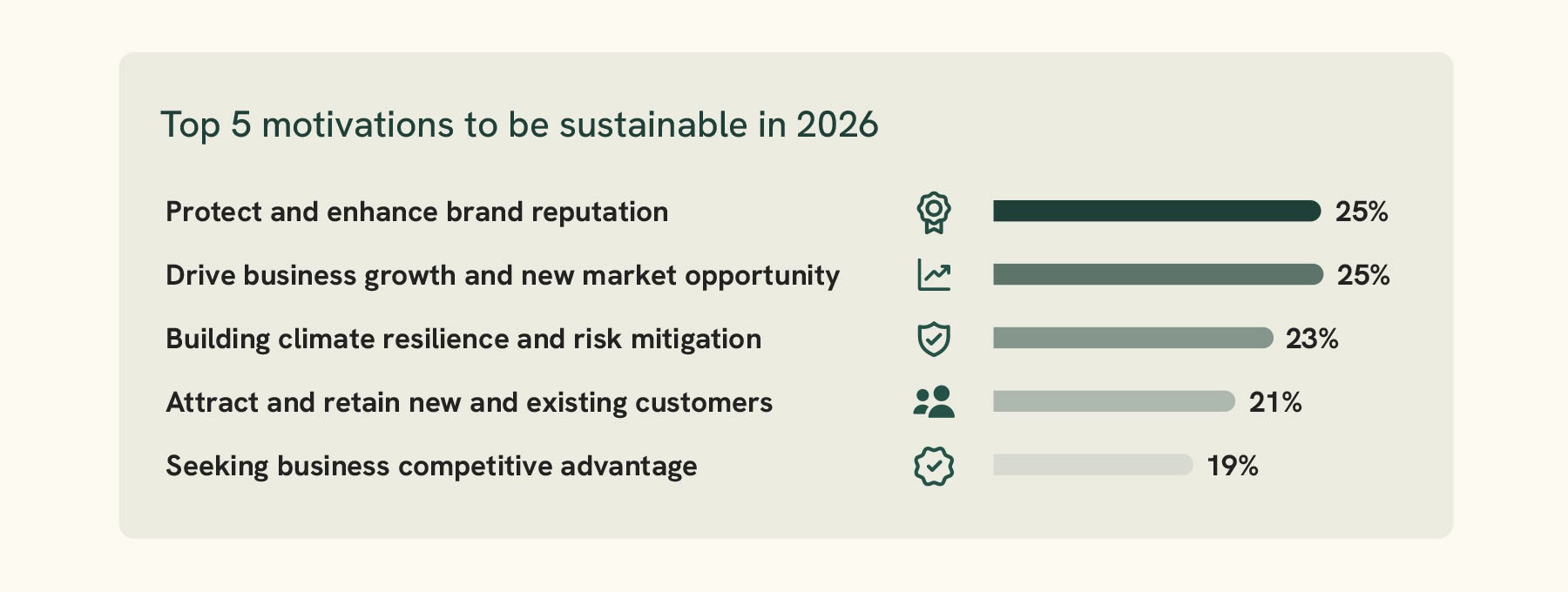
The motivations driving businesses forward have also matured. In 2024, protecting brand reputation was the clear standout driver. By 2026, it has levelled into a joint priority alongside driving business growth and exploring new market opportunities, both cited by 25% of respondents. Sustainability has evolved from a reputational shield into a core engine for commercial expansion.
Top 5 motivations to be sustainable in 2026

The 10% of businesses that see no case for reducing emissions face a stark outlook.

In a market where nearly three-quarters of peers are actively decoupling their operations from carbon, they will increasingly be priced out of green supply chains, face escalating compliance penalties, and struggle to access capital from climate-conscious lenders.

When asked to identify the specific benefits they experienced, the top five findings from 2026 tell a clear story. Enhanced social responsibility leads the way, cited by 33% of businesses, closely followed by improved brand image and recognition and attracting more eco-conscious customers, both at 31%. Reduced costs and improved operational efficiency come in at 28%, with increased circularity and waste reduction rounding out the top five at 26%.

Top 5 benefits of becoming more sustainable in 2026

The financial rewards of decarbonisation

The commercial case for climate action is no longer theoretical. Among the 74% of businesses actively reducing their emissions, nearly all report experiencing measurable commercial benefits. Across all 12 benefit categories measured in the survey, an average of 41% of those businesses reported uplifts greater than 16%, indicating moderate to significant gains.

The returns span every dimension of business performance:

Commercial benefits from climate action

The businesses seeing the strongest returns are not just reducing costs. They are growing revenue, winning customers, and pulling ahead of competitors. Enterprise companies (1,000+ FTE) see the strongest revenue impact, with 32.4% reporting significant uplift compared to 10.2% of SMEs. Mid-sized businesses (250-999 FTE), meanwhile, see the strongest returns in customer retention and staff recruitment, where sustainability credentials still serve as a genuine differentiator.


The commercial evolution of sustainability drivers

The motivations driving businesses forward have also matured. In 2024, protecting brand reputation was the clear standout driver. By 2026, it has levelled into a joint priority alongside driving business growth and exploring new market opportunities, both cited by 25% of respondents. Sustainability has evolved from a reputational shield into a core engine for commercial expansion.

Top 5 motivations to be sustainable in 2026

The 10% of businesses that see no case for reducing emissions face a stark outlook.

In a market where nearly three-quarters of peers are actively decoupling their operations from carbon, they will increasingly be priced out of green supply chains, face escalating compliance penalties, and struggle to access capital from climate-conscious lenders.

What this means for your business

The 2026 data reflects a business community navigating genuine uncertainty while recognising that climate action, resilience, and long-term value creation are deeply interconnected. The direction of travel is positive. But the pace needs to accelerate.

Reducing emissions is the essential first step. But businesses that stop there remain vulnerable. Restoring the natural systems their operations depend on, and reporting transparently on progress, is what separates partial action from a genuinely resilient climate strategy.

The businesses that thrive in the years ahead will be those that take a hard look at where their organisation is vulnerable today: understanding their exposure to climate and nature risk, decoupling their supply chains from high-emission and fossil fuel dependencies, and building the operational resilience to withstand a more volatile world.

Explore our solutions or speak to our team to discover how we can help accelerate your climate action to drive your business forward.

Download Ecologi's 2026 Climate Commitments Report for the full findings.
From Risk to Reward: How UK businesses are building resilience to deliver long-term value

The 2026 data reflects a business community navigating genuine uncertainty while recognising that climate action, resilience, and long-term value creation are deeply interconnected. The direction of travel is positive. But the pace needs to accelerate.

Reducing emissions is the essential first step. But businesses that stop there remain vulnerable. Restoring the natural systems their operations depend on, and reporting transparently on progress, is what separates partial action from a genuinely resilient climate strategy.

The businesses that thrive in the years ahead will be those that take a hard look at where their organisation is vulnerable today: understanding their exposure to climate and nature risk, decoupling their supply chains from high-emission and fossil fuel dependencies, and building the operational resilience to withstand a more volatile world.

Explore our solutions or speak to our team to discover how we can help accelerate your climate action to drive your business forward.

Download Ecologi's 2026 Climate Commitments Report for the full findings.

From Risk to Reward: How UK businesses are building resilience to deliver long-term value

Is your business ready
to take climate action?

If this article has inspired your business to start its climate journey, talk to our team today.

Is your business ready
to take climate action?

If this article has inspired your business to start its climate journey, talk to our team today.

Is your business ready
to take climate action?

If this article has inspired your business to start its climate journey, talk to our team today.