
Why sequencing matters, and how to avoid common carbon credit mistakes

By
Director of Climate Science & Impact
7 min read


Why emissions reduction must come before carbon credits
Carbon credits have an important role to play in a corporate net-zero strategy. But that role is specific, and it comes later in the process than many businesses think. Understanding where carbon credits sit in the ‘mitigation hierarchy’ is one of the most important things a business can do before entering the voluntary carbon market (VCM).
The question of when businesses should use carbon credits is not a matter of preference or budget. It is a matter of scientific integrity, stakeholder credibility and long-term strategic coherence. Get the sequencing wrong and you risk undermining the credibility of your entire climate programme.
Best-practice guidelines dictate that internal emissions reductions must come before carbon credits. With that in mind, here’s how to think about the role of carbon credits in a net-zero strategy.
The scientific imperative
The starting point is the science. Global net-zero requires dramatic emissions reductions across every sector and every region. The Intergovernmental Panel on Climate Change (IPCC) is unambiguous about this: the primary task is to cut emissions at source, and to do so rapidly. Carbon credits do not change this reality. They do not substitute for the systemic changes required in how businesses operate, procure, travel, and use energy.
A business that buys carbon credits without a credible emissions reduction plan is not on a net-zero pathway. It is managing its reputation, not its emissions.
Accountability and credibility
Reducing your own emissions is fundamentally different from paying to avoid or remove emissions elsewhere. When you reduce emissions within your value chain, you are taking direct responsibility for what your business produces. When you buy carbon credits, you are financing climate action beyond your value chain, which is valuable, but it does not replace that direct accountability.
Stakeholders understand this distinction. Investors and customers are applying increasing scrutiny to corporate climate claims, and a strategy built primarily on carbon credits rather than genuine operational reductions is unlikely to hold up. Companies that try to use carbon credits to bypass or delay their own decarbonisation tend to find themselves on the wrong side of this scrutiny sooner or later.
Net-zero architecture requires the right order
Under frameworks like the Science Based Targets initiative (SBTi) and the Oxford Principles for Net Zero Aligned Carbon Offsetting, carbon credits sit within a clearly defined architecture. The mitigation hierarchy for businesses sets out the correct sequence: measure your emissions, set a science-based target, reduce emissions across all scopes, and only then consider how carbon credits and broader climate contributions fit in.
Skipping steps or reordering this sequence creates both reputational risk and a broader structural misalignment with the frameworks your investors, customers and regulators are increasingly assessing you against.
What the mitigation hierarchy means in practice
The mitigation hierarchy is not a bureaucratic checklist. It is a logical framework that reflects how a credible corporate net-zero strategy is actually built. Understanding it clearly is essential before deciding how carbon credits fit into your net-zero strategy.
Measure
You cannot reduce what you do not understand. The first step is measuring your greenhouse gas emissions across Scope 1 (direct emissions), Scope 2 (purchased energy) and Scope 3 (value chain emissions). Carbon accounting at this level gives you the baseline from which everything else follows.
This is not a one-off exercise. Although the first time might take the longest, measurement should be annual, improving in accuracy over time, and tied to third-party verification. Without it, you have no way of knowing whether your reduction efforts are working, and no credible basis for any carbon claims you might want to make.
Set a target
Once you have a baseline, you need a target. Science-based targets are the recognised standard here - specifically, targets validated by the SBTi that align with limiting global warming to 1.5°C. These targets set out the pace and depth of reductions required across all scopes, and give your organisation a clear trajectory to work towards.
Targets without a credible plan to meet them are not useful. The target-setting process should involve a realistic assessment of where reductions are achievable, over what timeframe, and what investment is required to get there.
Reduce
This is where the substantive work of decarbonisation happens, and it is the heart of any credible net-zero strategy. Companies should pursue emissions reductions systematically across all scopes: switching to renewable energy, improving energy efficiency, decarbonising business travel, working with suppliers to reduce Scope 3 emissions, and redesigning products and processes where necessary.
Carbon reduction at this stage is direct, verifiable and unambiguous. It is also what gives your business the credibility to make carbon claims later.
Ongoing and residual emissions
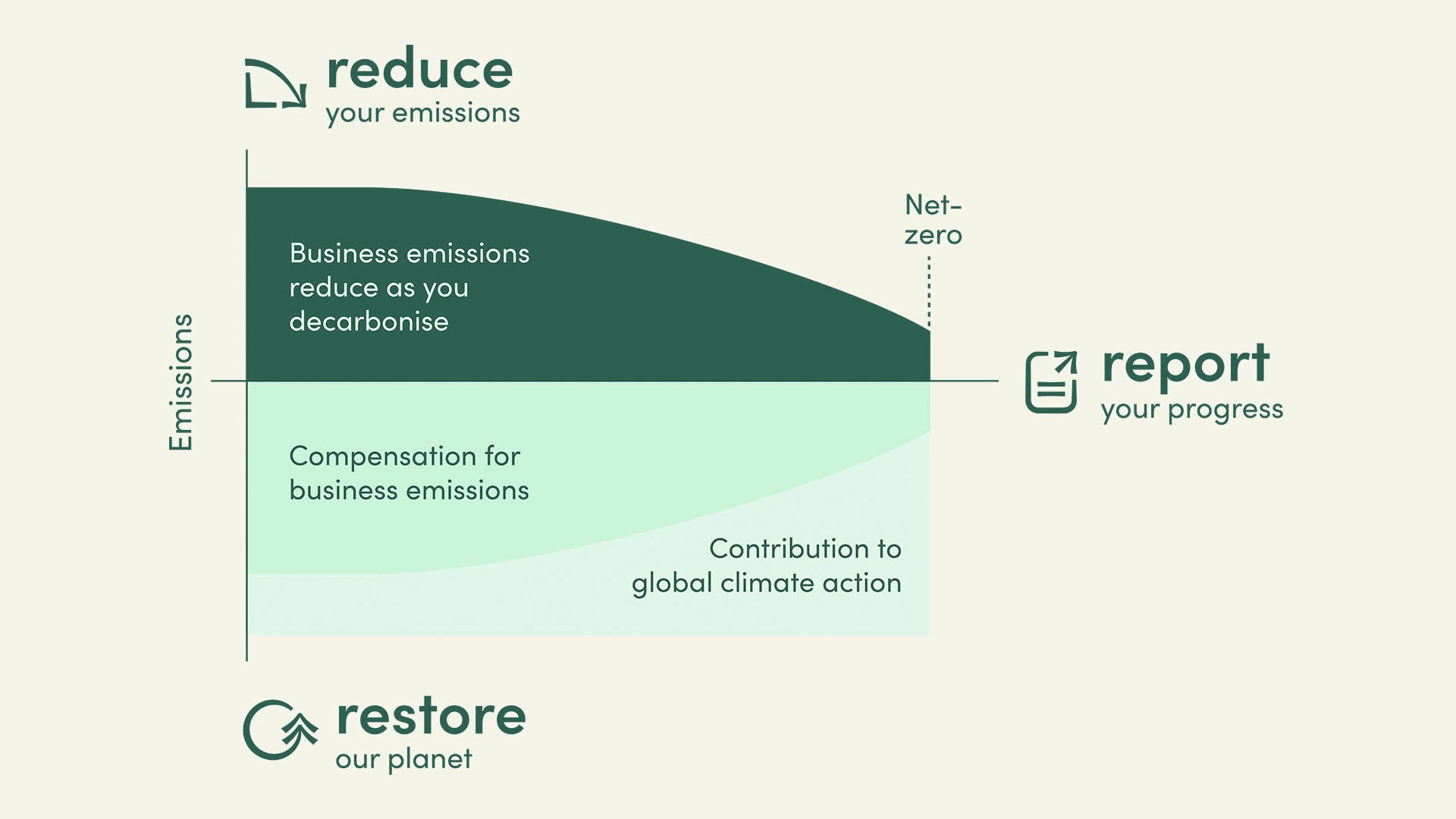
In practice, not all emissions can be eliminated. Reducing emissions takes time, leaving ‘ongoing emissions’ each year whilst you’re on your decarbonisation journey, and some emissions are technically or economically impossible to abate with current technology, even by your planned net-zero date. These are ‘residual emissions’ - the portion of your footprint that remains after you have reduced as much as is feasible.
Residual emissions are not a loophole. They are an honest acknowledgement of the limits of current decarbonisation technology and commercial reality. In practice, residual emissions tend to cluster in predictable places. Certain Scope 3 categories (purchased goods and services, upstream logistics, employee commuting) are genuinely difficult to influence directly, particularly for businesses without significant supply chain leverage. Process emissions in some manufacturing contexts cannot yet be eliminated with available technology. Business travel in sectors where in-person presence is commercially essential remains a stubborn source of hard-to-abate emissions for many organisations.
The SBTi expects residual emissions to represent less than 10% of a company's baseline by the net-zero target date - a useful benchmark for understanding how much work your reduction plan still needs to carry out before you can consider making net-zero claims.
Neutralisation at net-zero
Given that there will be some amount of residual emissions even after the net-zero date, the long-term goal is to neutralise those residual emissions with carbon removals - not avoidance credits, but the active removal of carbon dioxide from the atmosphere.
Under the SBTi framework, companies should address ongoing emissions throughout their journey with carbon credits, leading to a stage where they are ‘neutralising’ residual emissions at the net-zero date. That’s why the composition of a carbon credit portfolio needs to evolve over time: towards higher proportions of removal, and high proportions of removal with durable (very long-term) carbon storage.
This is the end state the mitigation hierarchy is designed to reach: a business that has reduced its emissions as far as possible, and is using high-quality carbon removals to address what genuinely cannot yet be eliminated.
How to sequence carbon credits properly
Understanding the mitigation hierarchy is one thing. Applying it to your actual procurement and strategy decisions is another. Here is what correct sequencing looks like for carbon credits in practice.
Ongoing and residual emissions only
Carbon credits should be sized against ongoing emissions only after reductions have been made against the baseline.
The right question is not "how many credits do we need to buy to call ourselves carbon neutral?" It is "what are our ongoing emissions for this year after maximum feasible reduction, and how do we address those responsibly?"
BVCM logic: contribution, not compensation
Beyond Value Chain Mitigation (BVCM) is the framework provided by the SBTi for businesses to support global climate action outside their own value chain. It is explicitly not compensatory. Carbon credits purchased as part of a BVCM strategy are contributions to global mitigation and climate solutions, not a mechanism for cancelling out your own ongoing emissions.
This framing matters for how you communicate your climate action, what claims you can and cannot make, and how you design your portfolio over time. Understanding that carbon credits sit within BVCM, and that BVCM is separate from your own decarbonisation pathway, is fundamental to getting the sequencing right.
Not a replacement for reductions
We’ll say it again: carbon credits cannot replace emissions reductions. Buying credits does not change your Scope 1, 2 or 3 footprint. It does not demonstrate decarbonisation. And it does not satisfy the requirements of a science-based net-zero target.
Carbon credits that are bought in place of emissions reductions, or used to delay decarbonisation investment, are not aligned with best practice and will not hold up to the scrutiny being applied to corporate climate claims.
The risks of getting this wrong
Misunderstanding the mitigation hierarchy (or knowingly departing from it) creates serious, specific risks for businesses.
Credibility collapse
A business that positions carbon credits as the foundation of its climate strategy, rather than a complement to deep reductions, is vulnerable. When investors, journalists or campaign groups examine the strategy and find that emissions have not actually reduced, the reputational damage can be significant and lasting. The credibility of your net-zero strategy depends on the mitigation hierarchy being followed in the right order. Shortcuts might be tempting, but they’re incredibly easy to see through.
Audit and disclosure failure
As mandatory climate disclosure requirements come into force, the accuracy and integrity of corporate climate reporting are under increasing scrutiny. A strategy that relies on carbon credits to mask unreduced emissions will not withstand an audit. Disclosures that overstate the role of credits, or that fail to separate BVCM contributions from actual emissions reductions, create material risk.
Carbon neutrality and net-zero claims made without the underlying reduction evidence are increasingly likely to attract regulatory attention under consumer protection and greenwashing frameworks.
Claims invalidation
If your carbon claims, whether "carbon neutral", "net-zero aligned" or similar, rest on carbon credits used in a way that does not follow the mitigation hierarchy, those claims are vulnerable to challenge. Guidance from the VCMI, the SBTi and ISO 14068 is increasingly clear on what claims require what evidence. Claims built on a shaky foundation might get you into the headlines (not in a positive way), and they may need to be withdrawn, which creates its own set of problems.
What this means for your strategy next
Getting this step right shapes everything that follows. If your business does not yet have a credible emissions reduction plan in place, the priority is to build one before focusing heavily on carbon credit procurement. If you do have one, then the task is to clearly define your residual emissions trajectory (how much you expect to remain, and over what timeframe) so that your carbon credit strategy can be sized and structured accordingly.
Carbon credits in a net-zero strategy are most effective and most defensible when they are explicitly connected to a reduction pathway: when you can say clearly what you are reducing, at what pace, and why the carbon credits you are buying represent genuine additional climate contribution rather than a substitute for action you have not yet taken.
From here, the next step is understanding what makes a carbon credit high quality, because once you have determined how credits fit into your strategy, the question becomes which credits are worth buying and why.
Work with Ecologi
Understanding where carbon credits fit into a net-zero strategy is one of the first questions Ecologi works through with every business it supports. The mitigation hierarchy is not complex in principle, but applying it correctly to your specific emissions profile, reduction pathway and stakeholder context takes experience.
Ecologi helps businesses establish the right sequencing from the outset, ensuring that carbon credit strategies are built on a credible reduction foundation, aligned with recognised frameworks, and structured to evolve as your decarbonisation progresses. If you want to make sure your approach to carbon credits is in the right place within your broader climate strategy, speak to one of our climate experts to get started.