
A guide to building a carbon credit portfolio that evolves toward net zero

By
Director of Climate Science & Impact
15 min read


Introduction
As companies move from early climate action to long-term, integrated net-zero strategies, they are turning to best-practice guidelines, such as the Oxford Principles for carbon offsetting, for guidance.
The Oxford Principles provide a clear, science-based framework for how companies should use carbon credits as part of a credible climate strategy and how carbon credit portfolios should evolve toward net-zero.
Rather than treating offsetting as a static, year-by-year activity, the Principles define a direction of travel. They show how portfolios should evolve in composition over time, from a larger share of avoidance credits to a predominantly removal-credit portfolio, and from short-term storage to durable carbon removal. After all, a carbon portfolio is not a one-off purchase, but an ongoing commitment to funding climate action.
In practice, this means your carbon credit portfolio today should look very different from your portfolio in five or ten years’ time. The goal is not just to compensate for your emissions, but to actively support the global transition to a net-zero economy.
Why portfolio evolution matters
Best practice guidance for carbon credit portfolios comes from the Science-Based Targets Initiative (SBTi)’s guidance on Beyond Value Chain Mitigation (BVCM). While the organisation’s current guidance does not specifically require alignment with the Oxford Principles, upcoming Ongoing Emissions Responsibility (OER) requirements likely will require this. Evolving your portfolio in line with the Oxford Principles is a smart early move, allowing you to support scaling carbon removal while simultaneously helping your company plan financially for a 100% removals-based portfolio by your net-zero target date (necessary for achieving net-zero, regardless).
Scaling carbon removal
The voluntary carbon market today is still dominated by carbon avoidance and reduction projects. These include activities like protecting forests or improving energy efficiency, which prevent greenhouse emissions from occurring. These projects are important and will continue to play a role in the near term, but they do not remove carbon that is already in the atmosphere - something scientists say we must do in order to achieve net-zero.
To reach global net-zero, carbon removal must scale significantly. This includes both nature-based solutions, such as reforestation, and engineered solutions, such as biochar or direct air capture.
The Oxford Principles recognise this and require companies to begin shifting their portfolios toward removals over time. This is not something to leave until the final stages of a net-zero journey. It needs to start early, even if removals initially make up a relatively small share of the portfolio.
Durability shift
Alongside scaling removals, there is a second transition taking place: the move towards greater durability. When carbon is removed from the atmosphere, it needs to be stored. Some forms of storage are temporary, lasting decades. Others are highly durable, locking carbon away for centuries or longer.
The Oxford Principles make it clear that, over time, companies should move toward durable storage with a low risk of reversal. So while early portfolios may include a mix of nature-based removals and emerging durable solutions, as the net-zero date approaches, the balance shifts toward highly durable storage.
Why the focus on durability? Ultimately, long-term climate stability depends on carbon staying out of the atmosphere permanently, not just temporarily. Higher-durability credits tend to be more expensive, but the longer-lasting climate benefits are worth it.
What the four principles require
The Oxford Principles provide a science-based framework for how companies should approach carbon credit use in a net-zero context. First introduced in 2020 and updated in 2024, they respond to a market that has historically lacked clear standards, where low-cost credits were often used without a clear link to long-term climate goals.
Today, they act as a roadmap for building a carbon credit strategy that supports credible claims and evolves over time. Together, the four principles define both what companies should be doing now and how their approach needs to change as they move toward net-zero.
1 — Reduce emissions first, ensure integrity, and maintain transparency
The first principle is made up of three core components:
1A. Prioritise reducing your direct and indirect emissions
Companies are expected to focus first on reducing emissions across their own operations and value chains. Carbon credits are not a substitute for decarbonisation. They are used to address ongoing or residual emissions once meaningful reductions have been made.
This aligns with frameworks like the Science Based Targets initiative (SBTi), which assumes companies have already set and are working toward science-based emissions reduction targets before investing in beyond value chain mitigation.
1B. Ensure the integrity of carbon credits
When credits are used, they must meet high standards of environmental integrity. This means ensuring projects deliver real, measurable, and additional climate benefits, supported by strong governance, verification, and transparency. In practice, this requires moving beyond surface-level claims and assessing project-level quality, including additionality, permanence, and risk of reversal.
1C. Maintain transparency and update your strategy over time
Companies should clearly communicate how carbon credits are being used and ensure their approach evolves alongside best practice. What qualifies as “high quality” is not fixed. Standards, methodologies, and market expectations are all developing quickly. This means portfolios need to be actively reviewed and adjusted over time, rather than treated as a one-off decision.
2 — Transition to carbon removals
The second principle focuses on the shift from avoidance to removal credits.
Most credits available today are based on avoiding or reducing emissions, such as preventing deforestation. These projects remain important, but they are not sufficient for achieving net-zero on their own – because we have already produced too many greenhouse gas emissions which are already in the atmosphere.
To reach net-zero, companies need to gradually transition their portfolios toward carbon removals, which actively remove CO₂ from the atmosphere. This transition should happen over time, in line with both corporate net-zero targets and the global net-zero timeline.
There are practical constraints to consider. The carbon removal market is still relatively early-stage, with limited supply and higher costs. A gradual transition allows companies to build exposure while supporting the scaling of these solutions.
However, this does not mean waiting. Companies need to plan for this portfolio evolution ahead of time. As demand increases, high-quality removal credits are expected to become more constrained, particularly beyond 2030. Companies that plan ahead, including through forward contracts or offtake agreements, are more likely to secure access and manage costs over time.
3 — Shift to durable storage
As companies increase their use of carbon removals, the next step is to focus on durability. When CO₂ is removed from the atmosphere, it must be stored somewhere. Some storage methods are short-lived, while others lock carbon away for centuries or longer. The Oxford Principles make it clear that, over time, companies should prioritise removals with durable storage and a low risk of reversal.
In the near term, portfolios may include a mix of storage types. Over time, however, the expectation is to move toward highly durable solutions, where carbon is effectively locked away over long timescales.
This has direct implications for purchasing strategy. Durable removals are currently limited in supply and often more expensive, which means companies need to plan ahead. The earlier organisations begin building relationships with these projects, the lower the risk of supply constraints and price exposure in the future.
4 — Support the development of net-zero solutions
The final principle focuses on the role companies play in scaling the market. It is made up of several components:
4A. Use long-term agreements that are bankable and investable
Long-term purchasing agreements help provide the financial certainty needed for projects to get built. This is particularly important for newer carbon removal technologies.
4B. De-risk project finance
By committing early, companies can help reduce investment risk and unlock capital for high-integrity projects that might not otherwise be viable.
4C. Collaborate to develop the market
Working with peers, industry groups, and coalitions can help establish shared standards, improve transparency, and accelerate market development.
4D. Support ecosystem protection and restoration in its own right
Nature-based solutions should be supported not only for the carbon credits they generate, but for their broader environmental and social benefits. Ecosystem restoration plays a critical role in climate action, regardless of whether it is used for offsetting.
4E. Adopt and promote best practice
Companies are encouraged to adopt frameworks like the Oxford Principles and support their integration into standards, regulations, and corporate climate strategies.
4F. Invest in beyond value chain mitigation (BVCM)
This includes funding climate action outside the value chain to accelerate global progress, even where it does not directly contribute to offsetting emissions.
Together, these four principles form a clear progression. Reduce emissions first. Use high-quality credits for residual emissions. Transition toward removals, and then toward durable storage. Along the way, actively support the development of the solutions needed to reach net-zero. This is what it looks like to move from ad-hoc offsetting toward a carbon credit strategy that is aligned with long-term climate goals.
How to design an evolving portfolio
Aligning with the Oxford Principles means designing a portfolio that changes over time. The key is not to define a single “perfect” portfolio - and certainly not a static one - but to establish a clear trajectory for where your portfolio is headed.
As we have seen, one of the most critical components of the Oxford Principles is that your carbon credit portfolio is dynamic and evolves over time. In particular, this requires increasing the proportion of the portfolio that is carbon removal, and increasing the proportion of the carbon removal that has long-term durability, as the net-zero date approaches.
That means that you can design your portfolio for 2026 but your portfolio in 2030 will be different - and it will be different again in 2036, and so on. So the important thing to do today is to establish the overarching commitment to an Oxford Principles-aligned approach, and plan out what that looks like right now, and what it could look like in the future. Remember that the first Principle also says to continually review your approach to align it with best practice - so there will always be some uncertainty as to the exact shape of the portfolio over longer time horizons.
Let’s map it out.
Suppose your company’s carbon footprint in 2025 was 5,000 tCO₂e. Here’s how you could structure your portfolio if you started with the reporting period for 2025, following the guidance of the Oxford Principles and working towards a 90% absolute emissions reduction between now and 2050.
We’ll take in snapshots each five years between now and your net-zero date:
Reporting Year | Total CO₂e | % Avoidance | Tonnes Avoided | Example | % Removals | Example Removals Projects | Tonnes Removed |
2025 | 5,000 | 90% ⬇ | 4,500 | High-quality forest protection, improved cookstoves, landfill gas capture, etc. | 10% ⬆ | Primarily ARR, regenerative farming, some durable (e.g. biochar, ERW) | 500 |
2030 | 4,000 | 70% ⬇ | 2,800 | High-quality forest protection, improved cookstoves, landfill gas capture, etc. | 30% ⬆ | Primarily ARR, regenerative farming, some durable (e.g. biochar, ERW) | 1,200 |
2035 | 3,000 | 50% ⬇ | 1,500 | High-quality forest protection, improved cookstoves, landfill gas capture, etc. | 50% ⬆ | Mix of durable (biochar, ERW) and nature-based removal (e.g. ARR) | 1,500 |
2040 | 2,000 | 30% ⬇ | 600 | High-quality forest protection, improved cookstoves, landfill gas capture, etc. | 70% ⬆ | Mix of durable (biochar, ERW) and nature-based removal (e.g. ARR) | 1,400 |
2045 | 1,000 | 10% ⬇ | 100 | High-quality forest protection, improved cookstoves, landfill gas capture, etc. | 90% ⬆ | Durable removal only (biochar, ERW, DACS) | 900 |
2050 | 500 | 0% | 0 | High-quality forest protection, improved cookstoves, landfill gas capture, etc. | 100% | Durable removal only (biochar, ERW, DACS) | 500 |
Notice that to be Oxford Principles-aligned also requires adherence to the significant reduction in emissions (in the second column in the table above). It is not enough to continually offset your emissions with increasing carbon removal if your annual emissions remain the same from now to 2050. The example above follows a 90% absolute reduction, in line with the SBTi’s Corporate Net-Zero Standard which requires (a minimum of) 90% reduction by the long-term target date.
By setting an approach which is Oxford Principles-aligned, you ensure your BVCM doesn’t just balance against your emissions today, but actively contributes to building the enabling conditions for global net-zero in the future.
Increasing the share of removals
The most visible shift is the gradual increase in carbon removals. Early in the transition, most companies will rely heavily on avoidance credits, with a smaller allocation to removals. Over time, this balance changes, with removals making up an increasing share of the portfolio. By the time a company reaches its net-zero target, its tonne-for-tonne portfolio should be fully or almost fully composed of carbon removals.
Increasing durability over time
Alongside this, the durability of your removals should also increase. Initial portfolios may include a mix of nature-based removals and some durable solutions. As the market develops, companies should shift toward removals with longer storage durations and lower reversal risk. This dual transition ensures that portfolios are increasing the share of removals they buy but also improving the quality and permanence of those removals.
Planning ahead for supply
One of the most important practical considerations is timing. High-quality carbon removal projects are limited in supply, and demand is expected to increase significantly over the coming decade. Companies that wait too long to buy may find that the credits they need are either unavailable or significantly more expensive.
This is why forward planning is critical. Forward contracts and offtake agreements allow companies to secure access to future supply, often at more predictable pricing. They also provide the long-term demand signals needed to help scale the carbon removal market, meaning your company can play an important catalysing role in building the market.
How to build an Oxford Principles-aligned portfolio
As we have seen, one of the most important aspects of the Oxford Principles is that your portfolio must evolve over time. This means thinking not just about what your portfolio looks like today, but how it will change as you reduce emissions and move toward net-zero.
A useful way to approach this is to map your portfolio against your emissions trajectory. If your company is reducing emissions over time, your total need for carbon credits should decrease. At the same time, the composition of those credits should shift toward removals and greater durability.
Short-term
In the early years, your portfolio is likely to be dominated by high-quality avoidance credits, supported by a smaller allocation to carbon removals. These removal projects may include nature-based solutions and some early-stage durable options.
Medium-term
As you move into the mid-term, the share of removals increases. At this stage, portfolios typically include a mix of nature-based removals and more durable solutions, reflecting both market availability and growing demand.
Long-term
Closer to your net-zero target date, the portfolio shifts further toward the durable removals end of the spectrum. Avoidance credits are phased out of tonne-for-tonne mitigation, and the focus moves to carbon removals only. Within this, the emphasis is on highly durable storage, ensuring that residual emissions are balanced in a way that is consistent with your long-term climate goals.
It’s important to recognise that this is not a fixed plan. The Oxford Principles emphasise the need to regularly review and update your portfolio as best practice evolves, new technologies emerge, and market conditions change. Ultimately, the most effective portfolios are those that are designed with flexibility in mind, but anchored to a clear long-term direction.
Risks of static portfolios
Supply squeeze
A portfolio that does not evolve over time is exposed to future supply constraints. As more companies transition toward carbon removals, demand for high-quality projects is expected to increase significantly. If they don’t engage early with suppliers and set up arrangements such as forward purchasing and offtake agreements, companies may find that the companies they need are difficult to access.
Cost inflation
Carbon removal credits are already more expensive than avoidance credits, and prices are likely to rise as demand grows. Companies that delay the transition may be surprised by significantly higher costs in the future, particularly for durable removals. Early action helps manage this risk by securing supply ahead of time.
Non-alignment with best practice
A static portfolio may also fall out of alignment with evolving standards. Frameworks such as the SBTi increasingly expect companies to move toward carbon removals and durable storage as part of a credible net-zero strategy. Failing to do so can expose your company to both strategic and reputational risk.
Single point of failure
No carbon project is entirely risk-free. Individual projects can underperform for a variety of reasons, and projects within a certain category carry particular risk profiles. Spreading your investment not just across multiple projects but across multiple project types is therefore a responsible, risk-informed decision.
Work with Ecologi
Designing an Oxford Principles-aligned carbon credit portfolio requires careful planning, strong market insight, and ongoing management.
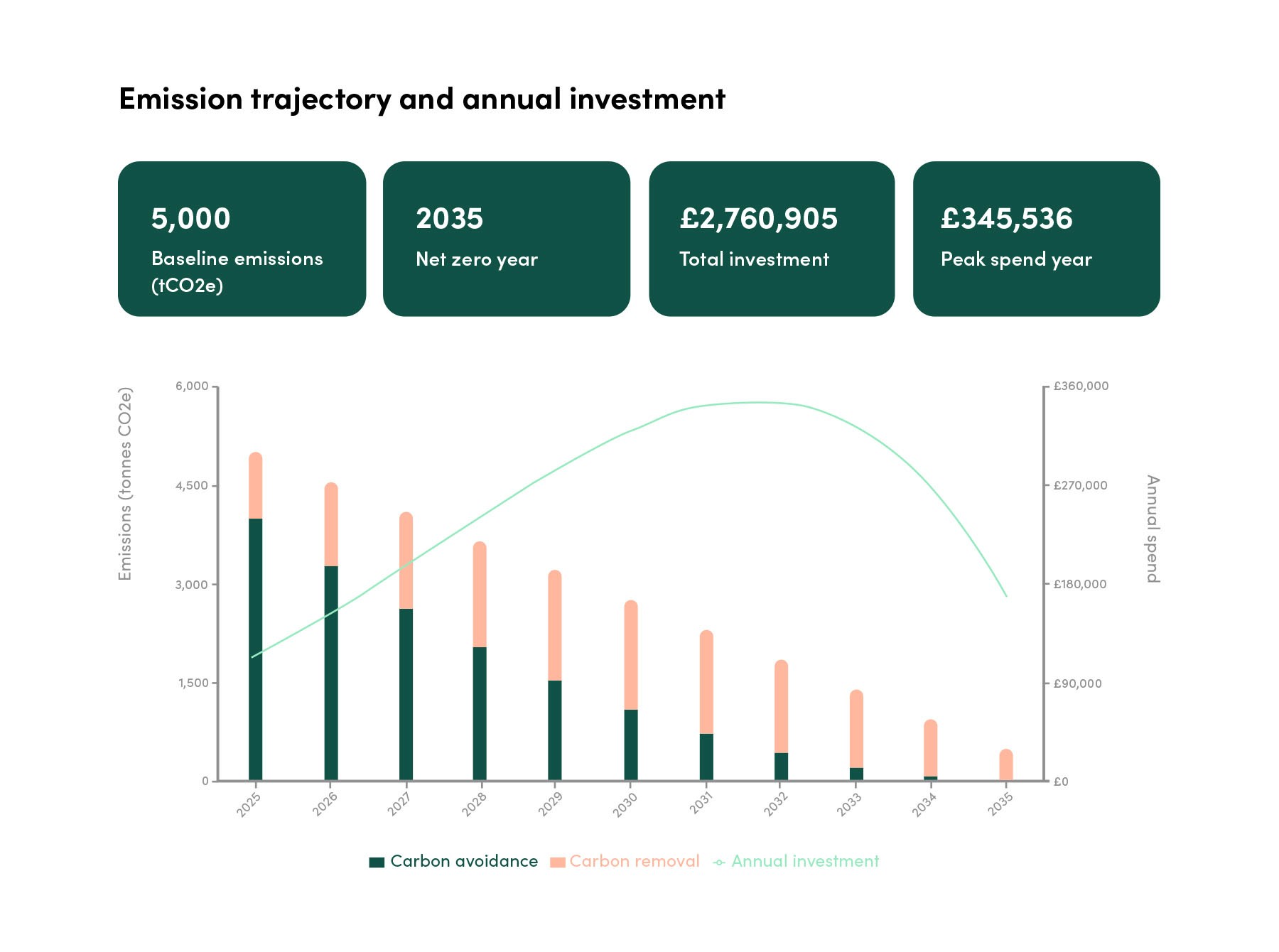
Here’s a visual example of Ecologi’s Oxford Principles-aligned portfolio breakdown by cost and project type over time:
Oxford Principles Case Study: Public Digital
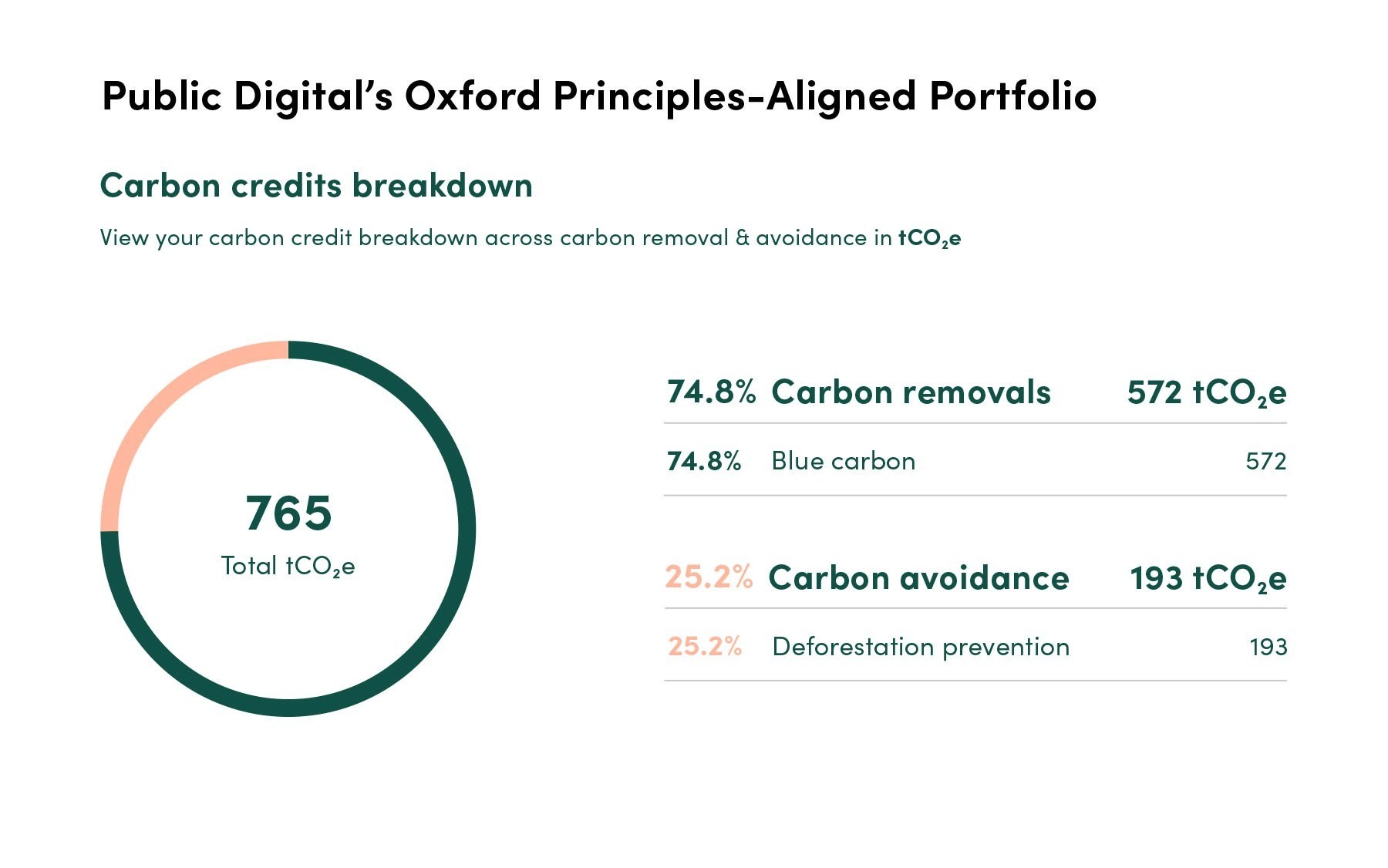
In line with its commitment to environmental responsibility, Public Digital (PD) has been diligently measuring and reducing its carbon footprint for several years, achieving a reduction of 21%, from 969.07 tCO₂e (2023) to 764.27 tCO₂e (2024). For its residual emissions, it has partnered with Ecologi to acquire high-quality carbon credits. This year, PD took a significant step by aligning its offsetting strategy with the Oxford Principles for Net Zero Aligned Carbon Offsetting.
The Oxford Principles recommend a blended portfolio of avoidance & removal credits, with a shift toward carbon removal to achieve net-zero goals. To this end, PD invested 75% of its offsetting portfolio into high-quality carbon removal credits from the Delta Blue Carbon project in Pakistan. This initiative is a prime example of a nature-based removal solution, focusing on mangrove restoration and conservation, which actively pulls carbon dioxide from the atmosphere.
The remaining 25% of its portfolio went to Nature Based Carbon Avoidance credits, generated through the protection of forests in Paraguay. As PD continues to reduce its overall carbon footprint, its plan is to progressively increase the proportion of carbon removal credits in its portfolio. This strategic and forward-looking approach demonstrates how companies can responsibly manage their residual emissions while contributing to the development of a robust and necessary carbon removal market.
Oxford Principles Case Study: Bytes Technology Group
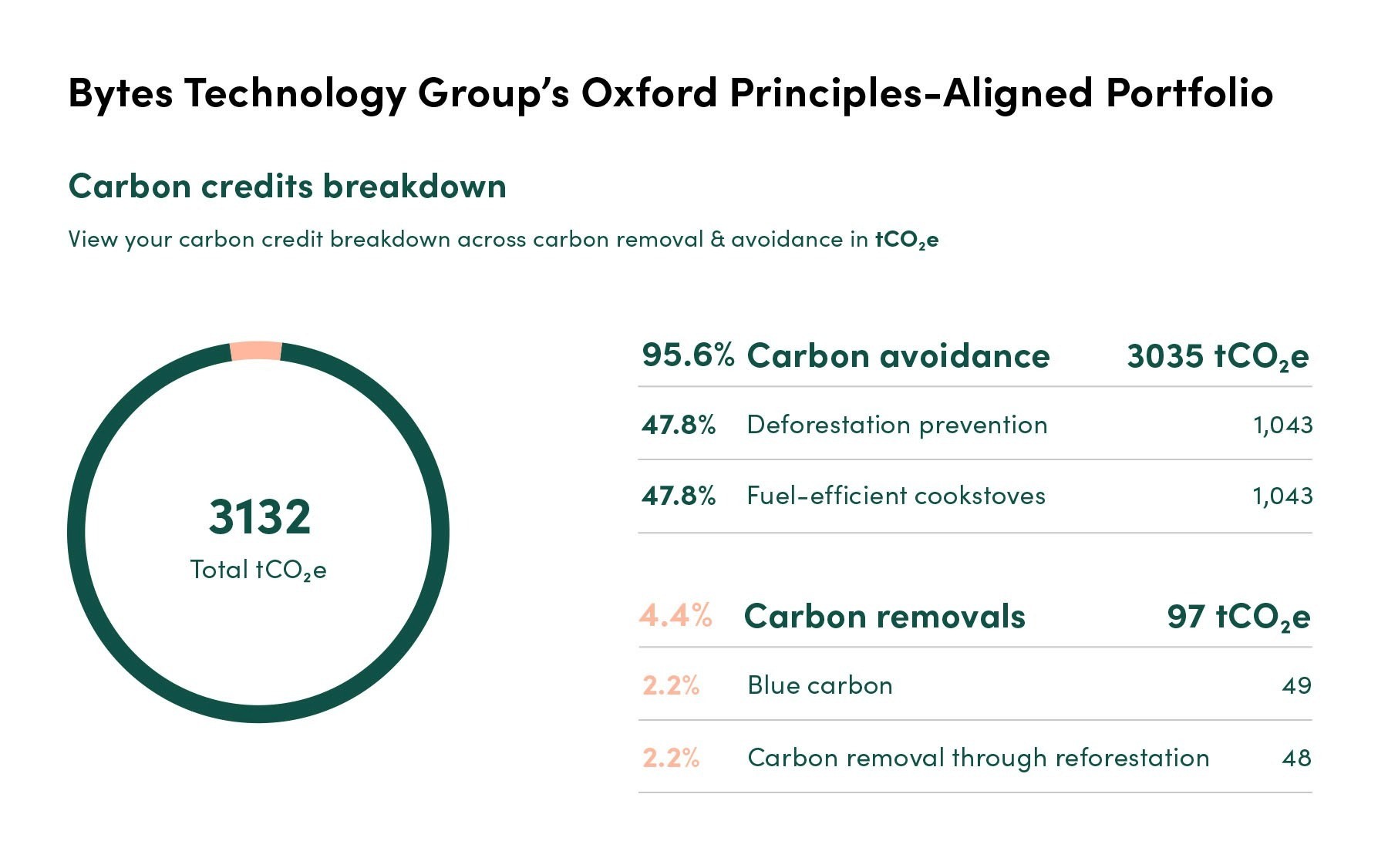
In line with its commitment to environmental responsibility, Bytes Technology Group’s two subsidiaries, Bytes Software Services and Phoenix Software, are taking significant steps to manage their residual emissions by investing in a diverse portfolio of high-quality carbon credits. This strategy aligns with the Oxford Principles for Net Zero, which recommend a blended portfolio of carbon avoidance and removal credits.
In the last reporting year Bytes Software Services has invested in high-integrity carbon removal projects - the Delta Blue Carbon mangrove restoration project in Pakistan and the Yarra Yarra Biodiversity Corridor in Australia, which actively remove carbon from the atmosphere, provide community benefits and increase biodiversity. Bytes invested in these to the value of their Scope 1 and 2 emissions, which comprise 4.4% of credits purchased. The remaining 95.6% were invested in projects that support community health and carbon avoidance through two impactful projects: the Mataven REDD+ project protecting vital rainforests in Colombia and the BURN Cookstoves initiative in Kenya, which reduces emissions while improving community health.
Phoenix Software reduced their Scope 1 and 2 emissions to zero in the last reporting year and so have taken an approach to cover a subset of scope 3 emissions through carbon removal credits. Phoenix has allocated a significant 20% of its portfolio to high-quality carbon removals. Crucially, these removal credits from the Delta Blue Carbon project are being used to specifically address the company's business travel emissions alongside some other scope 3 categories which will be particularly hard to abate. The remaining 80% of its portfolio supports the world-renowned Katingan REDD+ project, which prevents the emission of millions of tonnes of carbon by protecting vital peatland forests in Indonesia.
This strategic and forward-looking approach from Bytes Technology Group demonstrates how companies can responsibly manage their emissions today while helping to build the robust carbon removal market necessary for a true net-zero future.
Ecologi supports businesses in building dynamic portfolios that evolve toward net-zero. From sourcing high-quality projects to structuring long-term procurement strategies, the focus is on helping organisations align with best practice while managing risk and cost.
If you’re looking to align your carbon credit portfolio with the Oxford Principles, speak to one of our climate experts to get started.