

Carbon avoidance
Protecting lowland peat forest in Indonesia


Overview
Site
Benefits
Verification
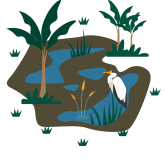
Why protect wetlands?
Wetlands, from peat bogs to salt marshes, are flooded habitats supporting specialised and endangered species. They store carbon efficiently and buffer communities against floods and droughts.
Project summary
Context
Peatlands are a type of wetland and are among the most valuable ecosystems on Earth. The term ‘peatland’ refers to the peat soil and the wetland habitat growing on its surface. Peat is a swampy, water-logged soil that is made through the slow accumulation of dead trees, plants, and other organic material which can only partially decompose due to the volume of water these habitats contain.
These unique habitats store massive amounts of carbon, with stocks below ground amounting to up to 20 times the amount stored in trees and vegetation. Despite covering just 3% of the Earth’s surface, they store more carbon than all other vegetation types in the world combined. When peatlands are cleared, drained or burned, the carbon stored within them is released into the atmosphere as carbon dioxide.
Indonesia contains some 36% of the world’s tropical peatlands, however they are increasingly being destroyed to make room for plantation crops including oil palm and acacia. From 2000 to 2015, the country lost an average of 498,000 hectares of forest each year.
Project
The Rimba Raya REDD+ project protects 64,500 hectares of lowland peat swamp forest from conversion to oil palm plantations. The project area is in Central Kalimantan province, on the Southern coast of Borneo. This area is incredibly rich in biodiversity, including being home to the endangered Bornean orangutan.
Provincial government in the area had previously slated the project area for conversion into four palm oil estates, and the project activity prevents this from taking place – ensuring the continued survival of the natural habitat for over 120 threatened and endangered species, and keeping the carbon stored in the trees and peatland locked away.
The project is the largest in the world to protect High Conservation Value (HCV) tropical lowland peat swamp, making enormous emissions reductions and protecting many species on the IUCN Red List. It is estimated to reduce over 3.5 million tonnes of emissions per year through preventing the clearing of the peatland.
Rimba Raya is also the first project supported by Ecologi to be certified by Verra’s Sustainable Development Verified Impact Standard (SDVista). This standard carefully scrutinises projects for their impacts toward the UN Sustainable Development Goals (SDGs). The project’s SDVista Validation Reports (which can be found here) note substantial contributions to all 17 of the SDGs.
These impacts come through various aspects of the project activity: from distributing solar lanterns to 1,794 local households, to providing sustainability education to 346 local students, to the building of two fire lookout towers on the project site to ensure rapid response to potential fire risks within the project boundary.
Verification
This project is verified by the Verified Carbon Standard (VCS) and the Climate, Community and Biodiversity Standard (CCBS). The project has also achieved certification by the Sustainable Development Verified Impact Standard (SDVista). You can view it on the Verra Registry here.
Climate solution #13
Peatland restoration
Peatlands, also known as bogs or mires, are neither solid ground nor water but something in between. Peat is a thick, mucky substance made up of dead and decomposing plant matter. It develops over hundreds, even thousands of years, as wetland vegetation slowly decays beneath a living layer of flora and in the near absence of oxygen.
Although these unique ecosystems cover just 3 percent of the earth’s land area, they are second only to oceans in the amount of carbon they store—twice that held by the world’s forests, at an estimated 500 to 600 gigatons. Protecting them through land preservation and fire prevention is a prime opportunity to manage global greenhouse gases.
Photos
Locations
Borneo, Indonesia
Benefits
SDGs supported


Verification
These partners help deliver the project and verify its impact.
Verifiers

Verified Carbon Standard
The Verified Carbon Standard (VCS) Program is the world's most widely used greenhouse gas (GHG) crediting program.
Climate, Community and Biodiversity Standard
Projects developed under the CCB Program must follow a rigorous assessment process to be certified. The CCB Standards are managed by Verra but were developed through a multi-stakeholder process by the Climate, Community & Biodiversity Alliance, a partnership of CARE, Conservation International, The Nature Conservancy, the Rainforest Alliance and the Wildlife Conservation Society.