Context
Bolivia, situated in South America, is the twelfth most biodiverse country in the world and if we rank all countries by the percentage of land covered by forest Bolivia would be sixth on that list, largely due to its substantial rainforest cover in the Bolivian Amazon. Roughly half of Bolivia is covered by forests (54.2% to be exact!), although only 16% is currently devoted to sustainable use. The low level of protection for Bolivia’s forests is of concern because the country has experienced a steady decline in forest cover since the 1990s. The reasons for this are many and varied, but include the clearing of land for agricultural purposes and increased international demand for timber, soil erosion from overgrazing and poor cultivation methods, pollution of water, fires, and ecosystems pressured beyond their productive capacity and potential.
The geography of Bolivia varies greatly, from the mountainous landscape in the West to the lowlands in the East, providing the climatic conditions required for a number of different types of forest. The Andes Mountains, which goes through the Western part of Bolivia, is the world’s longest mountain range. This mountain range is home to Polylepis forests.
The Polylepis forests are vital for protecting the water security of millions of people. The trees and their root systems slow the movement of glacial meltwater, ensuring its slow release into rivers and streams throughout the year. Their branches also effectively comb and harvest mists and precipitation from the clouds. As a result, permanent streams are created. This is vital for agriculture in mountainous areas, but also in lowland towns and villages where glacial meltwater is a key source of water. The trees also prevent soil erosion and flooding, protecting homes and livelihoods.
The forests also help to buffer the local climate from the impacts of climate change, through evapotranspiration – keeping the local climate cooler and wetter than it would be without the trees. Not only that, but the trees and the healthy soils associated with the trees are an important carbon store, playing a crucial role in the global fight against climate change.
An abundance of wildlife lives within these forests, including Andean Condors, Spectacled Bears, and Pumas. The forests are expected to become a habitat of increasing value due to the migration of species to cooler areas to escape the impact of climate change and the associated warming temperatures.
Unfortunately, Polylepis forests in the Andes have been threatened for some time now by deforestation. Indigenous and local communities who live close to the remaining forests are working with local tree-planting organisations to protect the remaining native forests and restore areas that have been deforested, planting a range of native species, including Polylepis.
Planting Partner
Global Forest Generation (GFG) is a US-based 510 (c)(3) conservation non-profit organisation that was created to address the biggest challenges facing large-scale forest ecosystem restoration projects.

Having identified a lack of restoration leaders and projects needed to protect vital ecosystems and restore degraded ecosystems to combat climate change, GFG’s team of experienced conservationists began establishing partnerships with local grass-roots leaders and communities. In 2018 GFG and Peruvian-based NGO ECOAN co-founded Acción Andina, a network of grassroots conservation partnerships aiming to protect 500,000 hectares of remaining Polylepis forest, and restore another 500,000 hectares of high Andean forest in buffer zones and areas of importance downslope from glaciers.
GFG provides the capacity building, reliable funding, technology, and collaborative networks that many grass-roots restoration leaders and projects wouldn’t otherwise have access to. Local leadership of projects is vital to their long-term success, and GFG supports communities to take ownership of the projects on their doorstep, ensuring their stewardship of the forest improves their own livelihoods, particularly food security and health. GFG also mentors the next generation of eco-restoration leaders to ensure the forests are protected for many years to come.
GFG’s implementing partners are local organisations working closely with local communities to plant the trees and protect remaining forest. In Bolivia, these partners are Asociación Armonia, and Faunagua.

The Project
The tree planting projects we will be supporting through GFG are part of a project spanning 5 countries in South America (Ecuador, Bolivia, Peru, Chile, and Argentina) called Acción Andina.
Ecologi will be funding the planting of 300,000 trees in the Andes mountains over the next 2 years. These trees will be planted across 16 different project sites, 2 of which will be in Bolivia.
In these Bolivian sites, 65% of the trees planted will be Polylepis subtusalbida, and the other 35% will be made up of other native species, including Alnus acuminata, Schinus molle, Jacaranda mimosifolia, Acacia visco, Tipuana Tipu, Erythrina falcata, and Buddleja coriácea.
We will be receiving quarterly reports on the progress of these projects, including regular photo updates to show our community the progress of the trees they’ve funded!
Explore the sites we’re supporting in Bolivia on Restor: Norte de Tunari, and Sur de Tunari.
Latest project update
In Bolivia, Faunagua held 10 workshops about the important ecological role Polylepis forests play, especially for water security.
While conducting these workshops, Faunagua staff were approached by a group of women from the community, Chiaraje, who expressed interest in participating in the project but who felt left out because they cannot read or write. Faunagua has now begun a literacy program in Chiaraje, which has resulted in even more support for the project.
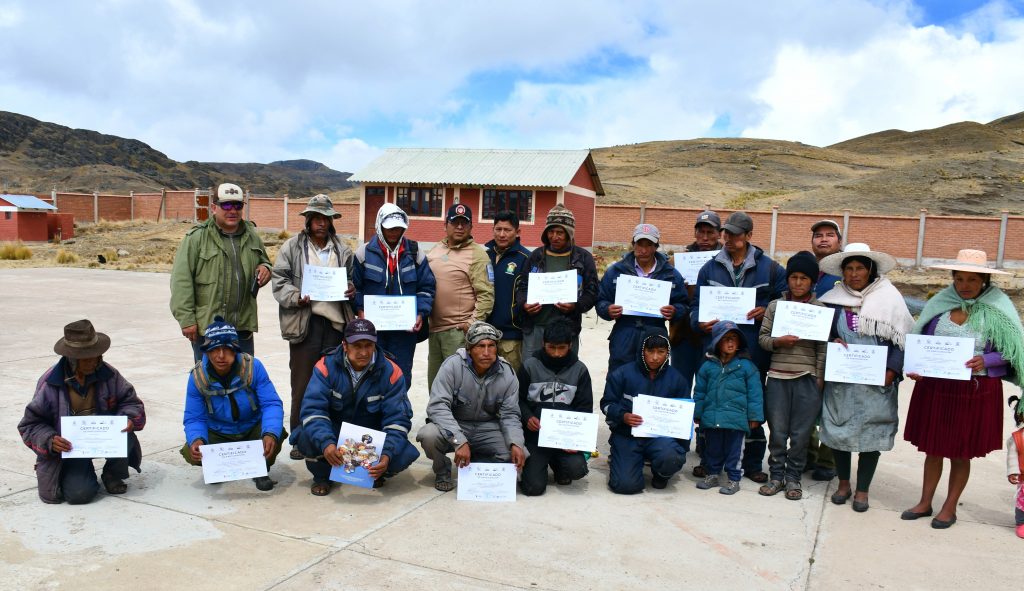
Volunteers attending a planting technique training receive certificates of participation in Chiaraje. Credit: Faunagua
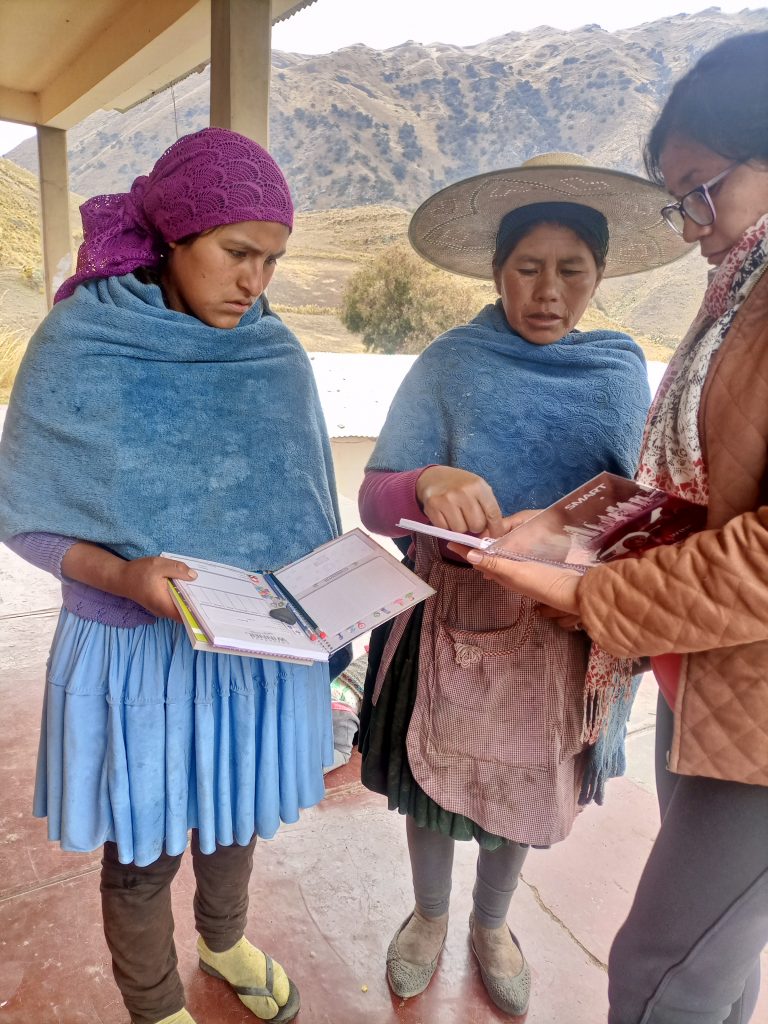
Literacy lesson being taught to women from Chiaraje community. Credit: Faunagua
Also in Bolivia, Faunagua has set up 80 efficient sprinkler systems in three communities, and Armonía improved an irrigation system in one community – services it emphasized in recent reports as being critical to securing community support and thus a vital component of the Acción Andina model.
And last but certainly not least, last Acción Andina season Armonía provided several training sessions and equipment to Cochabamba municipal volunteer firefighters and in two communities. A forest fire took place recently, which fortunately did not affect Armonía’s reforestation sites, but did start to enter a local community Armonía is not yet working with. Community members nearby who received training in the last year rushed to the aid of their neighbours and successfully extinguished the fire.
Climate Solution
Tropical Forest Restoration
It is estimated that 287 million hectares of degraded land in the tropics could be restored to continuous, intact forest. Using current and estimated commitments from the Bonn Challenge and New York Declaration on Forests, our model assumes that restoration could occur on 161-231 million hectares.
By protecting currently degraded land and allowing natural regrowth occur, committed land could sequester 1.4 tons of carbon dioxide per acre annually, for a total of 54.5-85.1 gigatons of carbon dioxide by 2050.
Photos from the project


