Context
Mozambique is located on the Eastern coast of Africa, with 2,500 kilometres of Indian Ocean coastline facing toward Madagascar.
Around 68% of the 31 million population of Mozambique live in its vast rural areas, and its population is relatively young – with around 66% of the country under the age of 24. Historically home to vast mangrove estuaries and forests, Mozambique’s forests have been largely decimated and destroyed due to intensive tree-cutting for firewood and charcoal.
In recent years, parts of Northern Mozambique have suffered from ongoing extremist threats. Conflict and unrest causes displacement to thousands of local Mozambican people. These ongoing conflicts also exacerbate existing development challenges such as providing access to education and healthcare. The population’s reliance on subsistence agriculture as a result of these challenges causes further environmental degradation.
Planting Partner
Our projects in Mozambique are run by Eden Reforestation Projects (‘Eden’) – a 501(c)(3) non-profit whose mission is to provide fair-wage employment to impoverished villagers as agents of global forest restoration.
Eden hire local people to grow, plant, and guard to maturity the trees planted through funding from our community – on a massive scale. As well as restoring forest ecosystems, Eden’s “Employ to Plant” methodology results in multiple positive socioeconomic and environment impacts.
Coastal mangrove restoration in Zambezia
The Irregele Milato planting site comprises 756 hectares in the Quelimane District of Zambezia Province, where today, local people often rely on fishing, agriculture and charcoal production for their livelihoods. The necessity for timber for income and for use in daily life has led to extensive deforestation in the area, and flooding in these deforested areas also causes further damage to the ecosystem and to people’s homes and property.
Mangroves are a small, coastal tree species that occur worldwide in the tropics and subtropics, and are particularly proficient at absorbing carbon and storing it in their extensive root systems underground. Carbon stored in mangrove forests is considered blue carbon, because it is stored on the coast. In addition to their excellent carbon sequestration abilities, mangroves provide excellent flood and storm protection to the coastal area itself.
Throughout the project period, our community will fund a projected 6 million mangrove trees in this planting site, which will help to stabilise the soil, absorb carbon, and provide employment to local planters and forest guards.
Explore the project further on Restor here.
Latest Site Update
Seeing Irregle Milato with our own eyes!
In May 2023, we were lucky enough to visit this amazing mangrove site and see some of the mangrove trees the Ecologi community has funded for ourselves. We’re pleased to report that the little mangrove trees are healthy and growing quickly! The Eden Reforestation Projects team on the ground there are really pleased with the progress of their project, especially because the local community has embraced the project fully and are working hard to protect the mangroves.
This site was recently in the path of tropical cyclone Freddy, a very intense cyclone that battered parts of Mozambique, Madagascar, and Malawi earlier in the year. We were worried about the impact of the cyclone on the project, but were relieved to see that the mangroves had not been damaged. The biggest impact of the cyclone on the mangroves was that the propagules, a bit like seeds for some species of mangrove, were blown away by the strong winds! This has made it difficult for the team to collect propagules for planting on the site, but at least the propagules that were blown away will end up in the ground somewhere! What’s more, the mangroves provide the local community with protection from some of the strongest winds. Sadly, we saw that there was a lot of damage in the village caused by the cyclone blowing down tall trees and destroying buildings, but the mangroves helped to prevent additional damage. The healthier the mangrove ecosystem becomes, the greater protection it will give to the local communities.
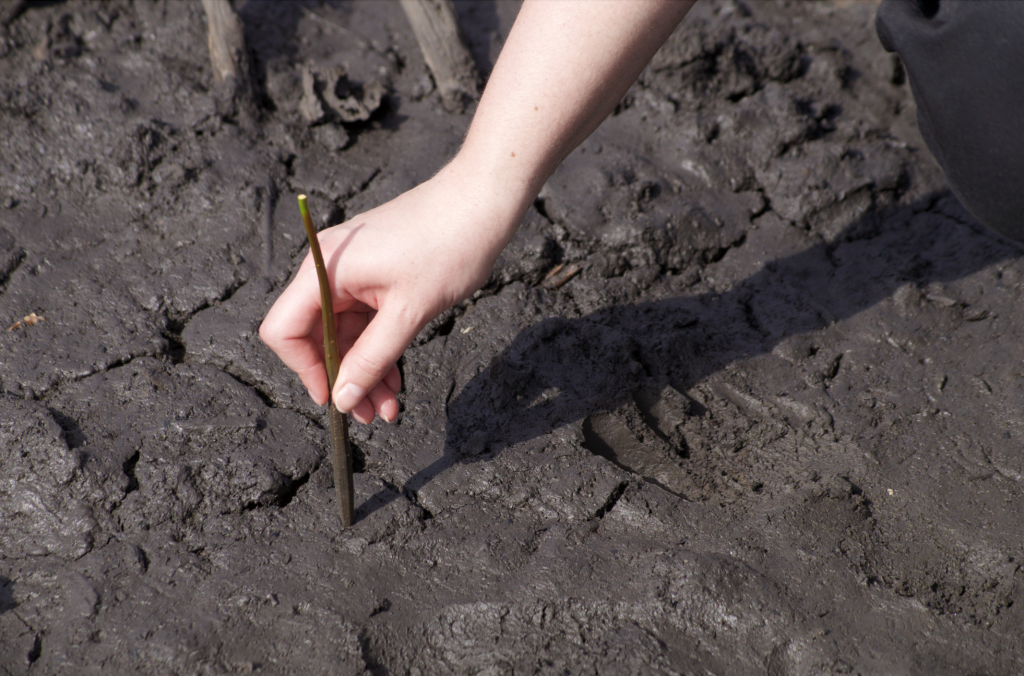
A Ceriops tagal propagule being planted. Hundreds of these were blown from the site by cyclone Freddy, but plenty remain to restore this project site.
Climate Solution #52
Coastal Wetland Restoration
Along the fringes of coasts, where land and ocean meet, lie the world’s salt marshes, mangroves, and sea grasses. These coastal wetland ecosystems are found on every continent except Antarctica.
They provide nurseries for fish, feeding grounds for migratory birds, a first line of defense against storm surges and floodwaters, and natural filtration systems that boost water quality and recharge aquifers. Relative to their land area, they also sequester huge amounts of carbon in plants aboveground and in roots and soils below.
Coastal wetlands can store five times as much carbon as tropical forests over the long term, mostly in deep wetland soils. The soil of mangrove forests alone may hold the equivalent of more than two years of global emissions—22 billion tons of carbon, much of which would escape if these ecosystems were lost.
Photos from this project


