
Mar 2026
Completion of Monitoring Report v1.4
- Finalised Monitoring Report v1.4 for the initial monitoring period of the third crediting period


More than 21,500 Kenyans die each year from cooking with traditional fuels like charcoal and firewood. The health risks are greatest in rural areas, where 90% of households use wood stoves, compared to 70% nationwide. Using these stoves is a significant health crisis. Burning firewood and charcoal indoors releases pollutants linked to pneumonia, stroke, ischemic heart disease, chronic obstructive pulmonary disease, and lung cancer.
High biomass consumption also drives deforestation, land degradation, and greenhouse gas emissions, while stripping soils of fertility and their ability to hold water.
Use of these stoves is also a time and opportunity cost, disproportionately carried by women and girls. Typically, mothers spend hours travelling to collect wood fuel; in some communities, this responsibility falls to daughters, who are also tasked with collecting firewood, keeping them from attending school.
This project focuses on distributing efficient, improved stoves, a significant transformation that enables a more sustainable, economical, and healthier way to cook.

Community projects bring climate action into everyday life, through changes such as more efficient cooking and better access to clean water. Using less fuel helps reduce emissions and pressure on surrounding forests. Depending on the project, it can also mean cleaner air at home and less time spent collecting firewood.
Project Developer
BURN, founded in 2010, leads this transition with Kenya’s first modern cookstove factory – still the only vertically integrated facility in sub-Saharan Africa. Powered by solar, it produces up to 400,000 stoves per month and employs 2,500 people, half women. By combining cleaner cooking with women’s economic empowerment, BURN shows how the energy transition can be both climate-positive and socially inclusive.
Objectives
The objective of the Burn Stoves Project in Kenya is to improve health and incomes throughout Kenya by reducing time and money spent acquiring fuel for household cooking.
The project activity includes the distribution of improved cookstoves for households in Kenya. The project stoves are expected to replace the traditional inefficient cookstoves used in the baseline. As a result, the project results in reductions of CO2 emissions that are real, measurable and provide long-term benefits to the mitigation of climate change.
Follow the latest milestones and updates from this project.
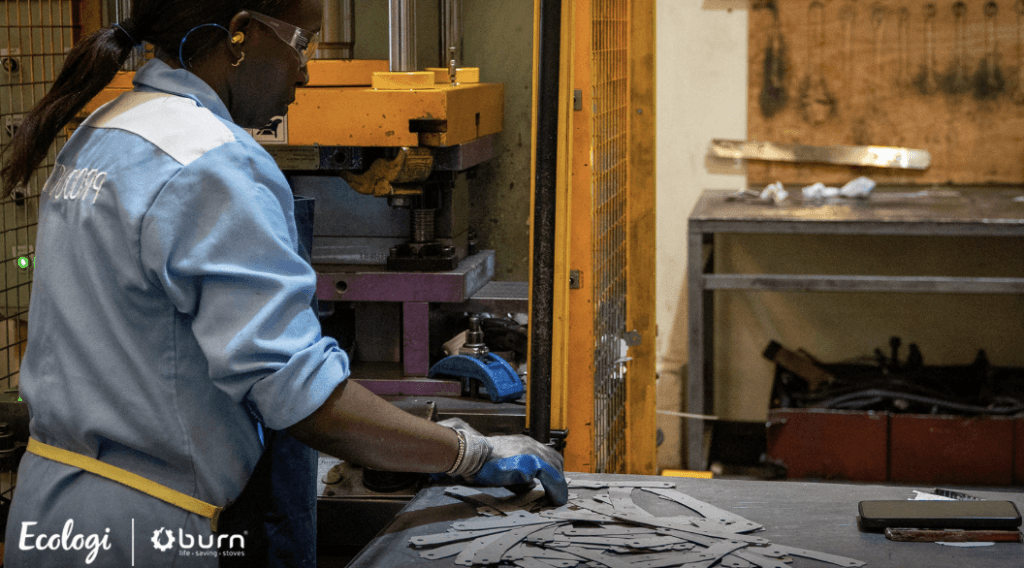
Earlier this year, Ecologi visited BURN’s Nairobi headquarters for a routine project assessment and deeper insight into its operations. The company is committed to hiring 50% female staff in its factory, ensuring that women, who are disproportionately affected by energy poverty, are at the heart of the solution. Walking through the manufacturing plant, we saw women leading production lines, operating heavy machinery, and setting the standard for what equitable, sustainable employment looks like. The factory is impressively modern, with clear signage and strict safety protocols evident throughout the site.
Ended 12th March 2024
Within the period:
Ended 13th March 2023
Within the period:
Ended 31st May 2019
Within the period:
Ended 30th December 2018
Within the period:
Ended 25th April 2017
Within the period:
Starting date of project
This project distributes fuel-efficient ‘Jikokoa’ cookstoves to communities around Kenya. The JikoKoa Stove saves about 0.57Kg of charcoal per day, which translates to about 204 Kgs/year. This in turn helps in reducing the GHG emissions to the atmosphere.
Over the lifetime of this project, over 380,000 cookstoves will be distributed, avoiding 4.3 million tonnes of CO2 emissions, and reducing demand for wood fuel by 2.4 million tonnes.
Air Quality: Less smoke and particulate matter means healthier air not just for people, but also for the local environment, improving soil and vegetation health around living spaces.
Reduced deforestation and improved biodiversity: Charcoal production and use is a major contributor to deforestation in Kenya. The continued demand for charcoal puts more pressure on the few remaining forests and this will continue if it is not reversed or contained. Reduced charcoal consumption for a given cooking demand will contribute to reduced deforestation.
Reduced fuel costs for households: Charcoal prices in Kenya can vary. An average kilo of charcoal goes for 50 shillings and with a savings of 0.57kg/day, a family can save up to 10,220 shillings in a year. Because the stoves are more fuel efficient than the baseline stove, the households switching to project stoves will save money that would have otherwise been used to buy charcoal. The savings will then be available to the households for alternative use.
Employment creation: Since the stoves are produced and sold in Kenya, the project activity has created employment across the stove supply chain from manufacturing, distribution, and sales of the stoves.
Access to energy services: The improved stoves use less fuel for a given cooking demand compared to the baseline stove. Charcoal, in a number of areas, can be scarce and/or expensive to buy, the project therefore increases their ability to access energy at minimal cost. The project stoves have also been found by users to be more convenient to use, with shorter cooking time.
Air quality: The stoves reduce indoor air pollution by 65%, generating health benefits for the families who rely on them.

The project helps reduce household expenses by cutting the amount of money spent on charcoal and firewood. For low-income households, fuel is a major recurring cost. By lowering fuel consumption, families can redirect savings toward food, education, healthcare, or small businesses. In addition, BURN creates stable employment across its value chain, providing income opportunities that help lift people out of poverty.

Reduced fuel needs mean households can cook meals more efficiently and consistently. Time saved from fuel collection can be used for food production, income-generating activities, or caregiving. Financial savings also improve food affordability, helping strengthen household food security.

Traditional biomass stoves produce high levels of indoor air pollution, which causes respiratory and cardiovascular diseases, especially among women and children. Improved cookstoves burn fuel more efficiently and cleanly, significantly reducing smoke exposure. This leads to better respiratory health, fewer illnesses, and lower healthcare costs.

By reducing fuel demand and the frequency of collection trips, the project frees up time for school attendance, homework, and rest. Improved health also means fewer missed school days due to illness.

Women and girls benefit directly from reduced fuel collection burdens and improved indoor air quality. The project also promotes women’s economic empowerment through employment—half of BURN’s workforce is female—and through reduced unpaid labor at home, allowing women more time for education, income generation, and leadership roles.

The project expands access to modern, energy-efficient cooking technologies, replacing inefficient traditional stoves. While biomass remains the fuel source, the stoves represent a cleaner and more sustainable energy solution, improving energy efficiency and affordability for millions of households.

BURN’s vertically integrated manufacturing facility creates thousands of formal jobs in Kenya, including skilled manufacturing, distribution, and sales roles. The factory’s use of solar power further supports sustainable industrial growth while strengthening local supply chains and the green economy.

In urban and peri-urban areas, improved charcoal stoves reduce demand for unsustainably sourced charcoal, helping limit deforestation linked to urban energy needs. Cleaner cooking also improves air quality and living conditions in dense settlements, contributing to healthier and more sustainable communities.

By reducing the amount of wood and charcoal burned, the project directly lowers greenhouse gas emissions and pressure on forests
These partners help deliver the project and verify its impact.

Over the past 10 years, BURN has built a successful business while proving that cookstoves can have transformative social, financial and environmental impacts.


The Core Carbon Principles (CCPs) are ten fundamental, science-based principles for identifying high-quality carbon credits that create real, verifiable climate impact. Developed with input from hundreds of organisations, they set a global benchmark for high integrity in the voluntary carbon market raising it to a consistent level of quality and ensure it accelerates progress towards the 1.5°C target.